The Great Miracle at Shravasti (c. 100 CE): Art, History and Details
The Great Miracle at Shravasti at the Cleveland Museum of Art: c. 100 CE, schist with traces of gold. Explore the work's context, creator attribution and collection history.
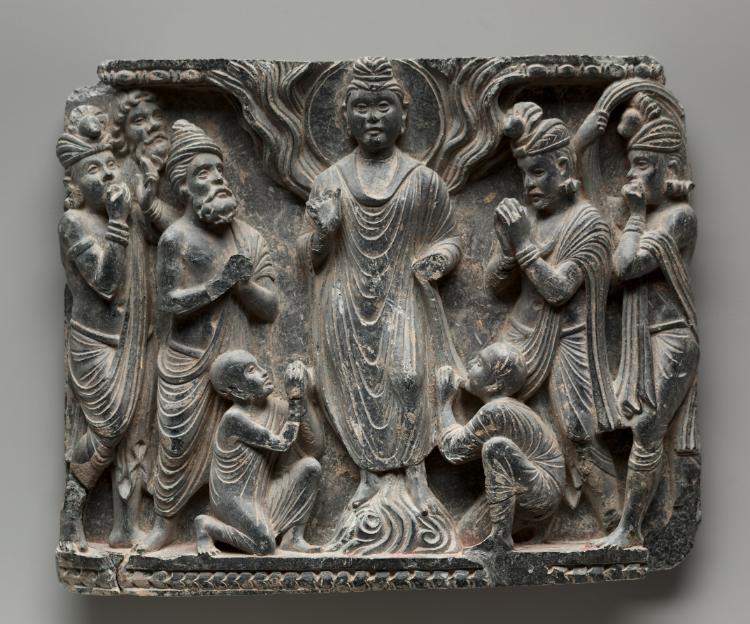
The Great Miracle at Shravasti (c. 100 CE) is in the Cleveland Museum of Art collection.
The work and its context
The museum's open-access catalogue describes the work:
After the Buddha reached enlightenment, he spent the remainder of his life traveling around northeastern India, giving teachings and performing miracles in order to convert followers and establish the Buddhist community. One of his most famous miracles is when he levitated and caused fire to leap from his shoulders and water to flow from his feet. The figures of two monks kneel in worship. Others press their hands together in a sign of devotion and submission, while the figures on the outer edges whistle and shake their upper garments, as was customary when an amazing sight was seen.
Object facts
- Title: The Great Miracle at Shravasti
- Date: c. 100 CE
- Culture: Pakistan, Gandhara, Peshawar Valley, early Kushan period
- Type: Sculpture
- Technique: schist with traces of gold
- Dimensions: Overall: 23.8 x 29.2 cm (9 3/8 x 11 1/2 in.)
- Collection: Indian Art - Kushan, Gandhara
- Department: Indian and Southeast Asian Art
- Accession number: 1975.102
Collection credit
Andrew R. and Martha Holden Jennings Fund
Further reading listed by the museum
- Lee, Sherman E. "The Year in Review for 1975." The Bulletin of the Cleveland Museum of Art 63, no. 2 (1976): 31-71.
- The Cleveland Museum of Art. Handbook of the Cleveland Museum of Art/1978. Cleveland, OH: The Cleveland Museum of Art, 1978.
- Czuma, Stanislaw J., and Rekha Morris. Kushan Sculpture: Images from Early India. Cleveland, OH: The Cleveland Museum of Art in cooperation with Indiana University Press, 1985.
View the collection record
See the museum's photographs and full catalogue entry. Catalogue text is reproduced from the Cleveland Museum of Art's open-access data, with HTML formatting removed. This object and its supplied image are designated CC0.
Sources
More in Lifestyle
Keep reading