The Holy Family in an Interior (1643): Art, History and Details
The Holy Family in an Interior at the Cleveland Museum of Art: 1643, etching, drypoint and engraving. Explore the work's context, creator attribution and collection history.
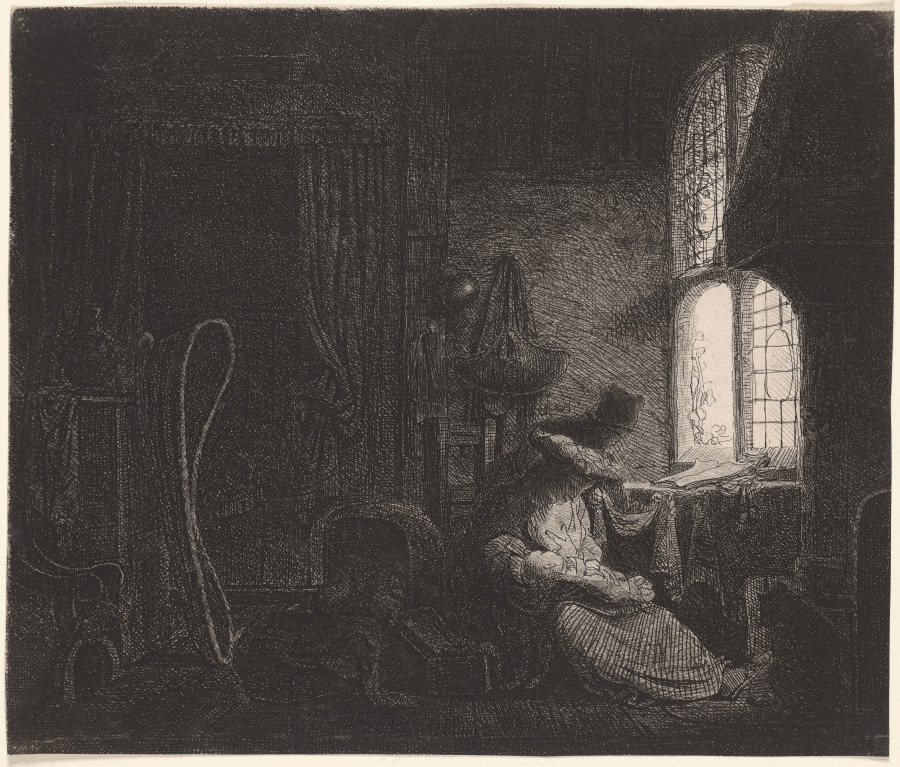
The Holy Family in an Interior (1643) is in the Cleveland Museum of Art collection. The museum's creator attribution is Ferdinand Bol (Dutch, 1616–1680).
The work and its context
The museum's open-access catalogue describes the work:
Ferdinand Bol made this etching just one year after he left the studio of his famous teacher, Rembrandt van Rijn, adopting his master’s motif of a dark domestic interior as the setting for a biblical scene. Here, Mary, Joseph, and Jesus sit within a contemporary Dutch interior with the light from a window the sole source of illumination, revealing an open book at a small desk. The rest of the room is in deep shadow. As Mary nurses the child, Joseph stands by with a swaddling cloth. To their left is a curtained cupboard bed of the type commonly found within Dutch living rooms, a bassinet, a nursing basket set on its end, a chair, and various vessels and containers. To the right of the family is a hearth and the barely discernible cat, calmly watching the scene. Bol’s broad, meshed lines simultaneously darken the room and reveal the various, closely observed domestic objects related to caring for an infant.
Object facts
- Title: The Holy Family in an Interior
- Date: 1643
- Creator attribution: Ferdinand Bol (Dutch, 1616–1680)
- Culture: Netherlands
- Type: Print
- Technique: etching, drypoint and engraving
- Dimensions: Sheet: 18.2 x 21.6 cm (7 3/16 x 8 1/2 in.)
- Collection: PR - Etching
- Department: Prints
- Accession number: 2024.85
A detail from the museum
The tall basket laid on its end visible in this composition is a bakermat, a legless couch typical in 17th-century Netherlands that was placed on the floor for nursing.
Collection credit
Purchase from the J. H. Wade Fund
View the collection record
See the museum's photographs and full catalogue entry. Catalogue text is reproduced from the Cleveland Museum of Art's open-access data, with HTML formatting removed. This object and its supplied image are designated CC0.
Sources
More in Lifestyle
Keep reading