The hunter offers the mother parrot to the king of Kamarupa, from a Tuti-nama (Tales of a Parrot): Fifth Night (c. 1560): Art, History and Details
The hunter offers the mother parrot to the king of Kamarupa, from a Tuti-nama (Tales of a Parrot): Fifth Night at the Cleveland Museum of Art: c. 1560, gum tempera, ink, and gold on paper. Explore the work's context, creator attribution and
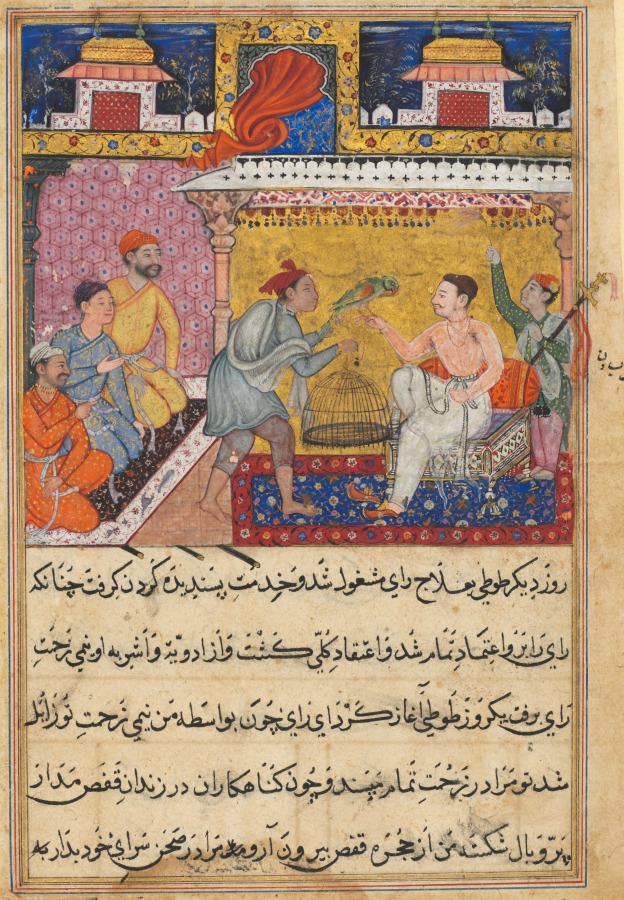
The hunter offers the mother parrot to the king of Kamarupa, from a Tuti-nama (Tales of a Parrot): Fifth Night (c. 1560) is in the Cleveland Museum of Art collection. The museum's creator attribution is Basavana (Indian, active c. 1560–1600).
The work and its context
The museum's open-access catalogue describes the work:
The king of Kamarupa, which ironically means “body of erotic love,” had leprosy. The hunter brought the captured mother parrot to the king, assuring him that the bird knew a cure. The lavish use of gold indicates that this book was a costly production. The figure of the hunter reveals the talents of the artist Basavana, whose name is written in the right margin. Draped in rustic garments shaded to appear softly flowing, the hunter bends forward with a subtle look of shrewd expectancy as the king seems ready to pay a high price for the parrot. The billowing red curtain is one of Basavana’s signature motifs. Beyond is a tantalizing glimpse of the forest to which the parrot will soon escape to rejoin her children.
Object facts
- Title: The hunter offers the mother parrot to the king of Kamarupa, from a Tuti-nama (Tales of a Parrot): Fifth Night
- Date: c. 1560
- Creator attribution: Basavana (Indian, active c. 1560–1600)
- Culture: Mughal India, court of Akbar (reigned 1556–1605)
- Type: Painting
- Technique: gum tempera, ink, and gold on paper
- Dimensions: Overall: 20 x 14.3 cm (7 7/8 x 5 5/8 in.); Painting only: 10.2 x 10.7 cm (4 x 4 3/16 in.)
- Collection: Indian Art
- Department: Indian and Southeast Asian Art
- Accession number: 1962.279.36.b
A detail from the museum
This leper king ruled a territory that stretched from Bhutan to Assam and Bengal.
Collection credit
Gift of Mrs. A. Dean Perry
Further reading listed by the museum
- Chandra, Pramod, and Daniel J. Ehnbom. The Cleveland Tuti-Nama Manuscript and the Origins of Mughal Painting. Cleveland, OH: The Cleveland Museum of Art, 1976.
- Seyller, John. “Overpainting in the Cleveland T̤ūtīnāma.” Artibus Asiae 52, no. 3/4 (1992): 283–318.
- Corriveau, Bethany. “Yearly Traditions Old and New.” Cleveland Art: Cleveland Museum of Art Members Magazine 56, no. 5 (September/October 2016): 29.
View the collection record
See the museum's photographs and full catalogue entry. Catalogue text is reproduced from the Cleveland Museum of Art's open-access data, with HTML formatting removed. This object and its supplied image are designated CC0.
Sources
More in Lifestyle
Keep reading