The king dreams of a lady, the personification of wealth, departing from him on account of his purchasing a bowl and a staff from a yogi, from a Tuti-nama (Tales of a Parrot): Thirty-sixth Night (c. 1
The king dreams of a lady, the personification of wealth, departing from him on account of his purchasing a bowl and a staff from a yogi, from a Tuti-nama (Tales of a Parrot): Thirty-sixth Night at the Cleveland Museum of Art: c. 1560, gum
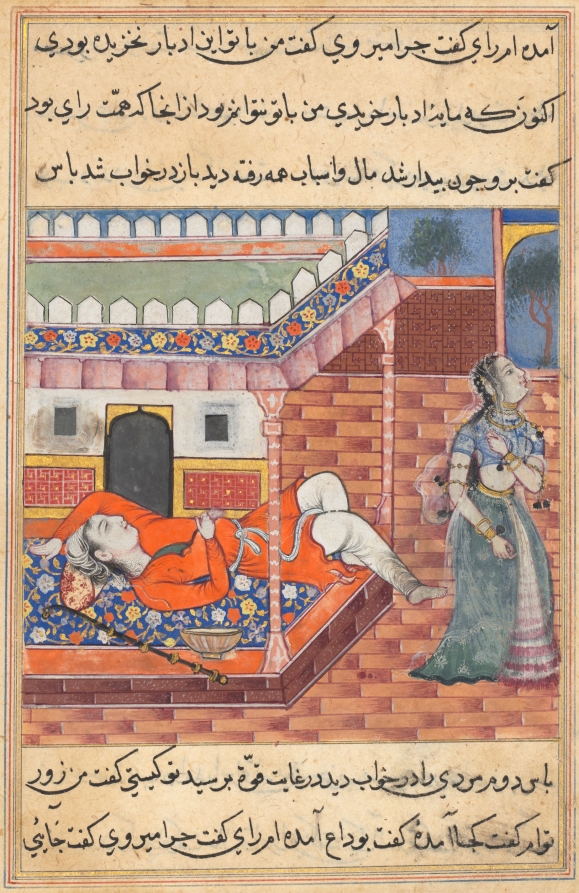
The king dreams of a lady, the personification of wealth, departing from him on account of his purchasing a bowl and a staff from a yogi, from a Tuti-nama (Tales of a Parrot): Thirty-sixth Night (c. 1560) is in the Cleveland Museum of Art collection.
The work and its context
The museum's open-access catalogue describes the work:
The sleeping king lies sprawled across a bed with the bowl and staff at his side. These inauspicious purchases represent his impending loss of wealth. He allows the woman to leave and, upon waking, finds that all of his possessions have disappeared.
Object facts
- Title: The king dreams of a lady, the personification of wealth, departing from him on account of his purchasing a bowl and a staff from a yogi, from a Tuti-nama (Tales of a Parrot): Thirty-sixth Night
- Date: c. 1560
- Culture: Mughal India, court of Akbar (reigned 1556–1605)
- Type: Painting
- Technique: gum tempera, ink, and gold on paper
- Dimensions: Overall: 20.3 x 14 cm (8 x 5 1/2 in.); Painting only: 10.1 x 10.2 cm (4 x 4 in.)
- Collection: Indian Art
- Department: Indian and Southeast Asian Art
- Accession number: 1962.279.239.b
A detail from the museum
The king experiences three more dreams, representing his strength, reason, and good deeds.
Collection credit
Gift of Mrs. A. Dean Perry
Further reading listed by the museum
- Chandra, Pramod, and Daniel J. Ehnbom. The Cleveland Tuti-Nama Manuscript and the Origins of Mughal Painting. [Cleveland]: Cleveland Museum of Art, 1976.
View the collection record
See the museum's photographs and full catalogue entry. Catalogue text is reproduced from the Cleveland Museum of Art's open-access data, with HTML formatting removed. This object and its supplied image are designated CC0.
Sources
More in Lifestyle
Keep reading