The king of the Ocean, having assumed human form, arrives at the court of the Raja, from a Tuti-nama (Tales of a Parrot): Eleventh Night (c. 1560): Art, History and Details
The king of the Ocean, having assumed human form, arrives at the court of the Raja, from a Tuti-nama (Tales of a Parrot): Eleventh Night at the Cleveland Museum of Art: c. 1560, gum tempera, ink, and gold on paper. Explore the work's contex
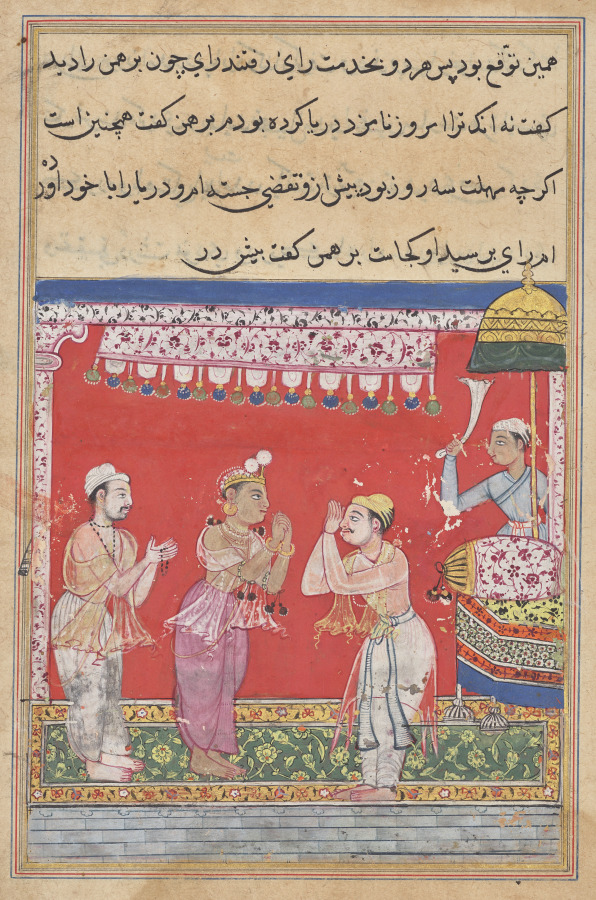
The king of the Ocean, having assumed human form, arrives at the court of the Raja, from a Tuti-nama (Tales of a Parrot): Eleventh Night (c. 1560) is in the Cleveland Museum of Art collection. The museum's creator attribution is Ghulam 'Ali (Indian, active 1550s-1590s).
The work and its context
The museum's open-access catalogue describes the work:
His hands raised in a gesture of respectful greeting, the Raja got down from his throne to welcome the king of the ocean, wearing a crown with white flowers. At the left, the Brahman holds a rosary in his hands. The raja wears the clothing and turban favored by Emperor Akbar: fine white muslin tunic with long points, pants, and a ready-tied flat turban. The king of the ocean is dressed like the Brahman, with a wrapped lower garment called a dhoti, and he wears a sacred thread over his left shoulder, which is the mark of a high-born Hindu.
Object facts
- Title: The king of the Ocean, having assumed human form, arrives at the court of the Raja, from a Tuti-nama (Tales of a Parrot): Eleventh Night
- Date: c. 1560
- Creator attribution: Ghulam 'Ali (Indian, active 1550s-1590s)
- Culture: Mughal India, court of Akbar (reigned 1556–1605)
- Type: Painting
- Technique: gum tempera, ink, and gold on paper
- Dimensions: Overall: 20 x 14.7 cm (7 7/8 x 5 13/16 in.); Painting only: 11.5 x 10.3 cm (4 1/2 x 4 1/16 in.)
- Collection: Indian Art
- Department: Indian and Southeast Asian Art
- Accession number: 1962.279.92.a
A detail from the museum
The umbrella over the seat at the right marks the throne of the Raja.
Collection credit
Gift of Mrs. A. Dean Perry
Further reading listed by the museum
- Chandra, Pramod, and Daniel J. Ehnbom. The Cleveland Tuti-Nama Manuscript and the Origins of Mughal Painting. [Cleveland]: Cleveland Museum of Art, 1976.
- Chandra, Pramod, and Daniel J. Ehnbom. The Cleveland Tuti-Nama Manuscript and the Origins of Mughal Painting. [Cleveland]: Cleveland Museum of Art, 1976.
View the collection record
See the museum's photographs and full catalogue entry. Catalogue text is reproduced from the Cleveland Museum of Art's open-access data, with HTML formatting removed. This object and its supplied image are designated CC0.
Sources
More in Lifestyle
Keep reading