The king plucks fruit from the Tree of Life with his own hands and feeds it to a lady, from a Tuti-nama (Tales of a Parrot): Ninth Night (c. 1560): Art, History and Details
The king plucks fruit from the Tree of Life with his own hands and feeds it to a lady, from a Tuti-nama (Tales of a Parrot): Ninth Night at the Cleveland Museum of Art: c. 1560, gum tempera, ink, and gold on paper. Explore the work's contex
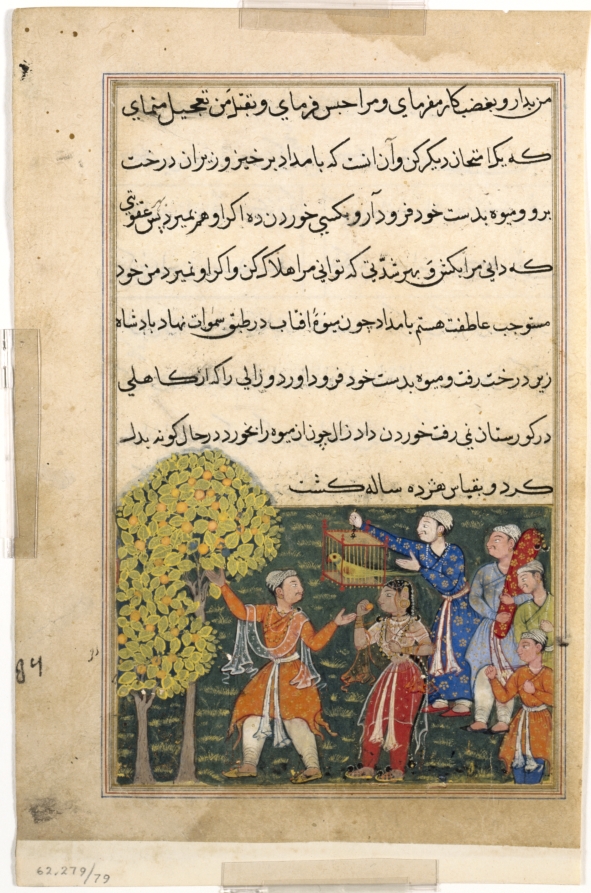
The king plucks fruit from the Tree of Life with his own hands and feeds it to a lady, from a Tuti-nama (Tales of a Parrot): Ninth Night (c. 1560) is in the Cleveland Museum of Art collection. The museum's creator attribution is Suraju (Indian).
The work and its context
The museum's open-access catalogue describes the work:
In order to prevent his own execution, the loyal parrot must prove to the king that the fruit of the Tree of Life is not poisonous. When the fruit restores the youth of an old man, the parrot is vindicated. He watches from his cage, alongside other members of the court, as the king happily picks from the tree.
Object facts
- Title: The king plucks fruit from the Tree of Life with his own hands and feeds it to a lady, from a Tuti-nama (Tales of a Parrot): Ninth Night
- Date: c. 1560
- Creator attribution: Suraju (Indian)
- Culture: Mughal India, court of Akbar (reigned 1556–1605)
- Type: Painting
- Technique: gum tempera, ink, and gold on paper
- Dimensions: Painting only: 7.7 x 10.1 cm (3 1/16 x 4 in.); Overall: 20 x 13.4 cm (7 7/8 x 5 1/4 in.)
- Collection: Indian Art
- Department: Indian and Southeast Asian Art
- Accession number: 1962.279.79.a
A detail from the museum
Black pom-poms on the woman's shoes, braid, and jewelry indicate the ends of ties.
Collection credit
Gift of Mrs. A. Dean Perry
Further reading listed by the museum
- Chandra, Pramod, and Daniel J. Ehnbom. The Cleveland Tuti-Nama Manuscript and the Origins of Mughal Painting. [Cleveland]: Cleveland Museum of Art, 1976.
- Chandra, Pramod, and Daniel J. Ehnbom. The Cleveland Tuti-Nama Manuscript and the Origins of Mughal Painting. [Cleveland]: Cleveland Museum of Art, 1976.
- Seyller, John. “Overpainting in the Cleveland T̤ūtīnāma.” Artibus Asiae 52, no. 3/4 (1992): 283-318.
View the collection record
See the museum's photographs and full catalogue entry. Catalogue text is reproduced from the Cleveland Museum of Art's open-access data, with HTML formatting removed. This object and its supplied image are designated CC0.
Sources
More in Lifestyle
Keep reading