The Large Passion: The Crucifixion (c. 1497–1500): Art, History and Details
The Large Passion: The Crucifixion at the Cleveland Museum of Art: c. 1497–1500, woodcut. Explore the work's context, creator attribution and collection history.
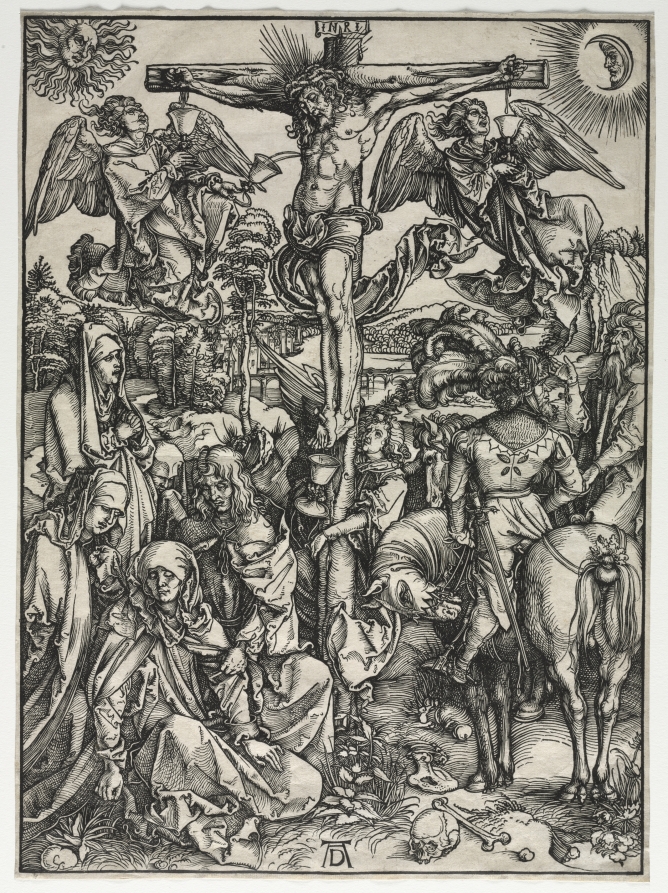
The Large Passion: The Crucifixion (c. 1497–1500) is in the Cleveland Museum of Art collection. The museum's creator attribution is Albrecht Dürer (German, 1471–1528).
The work and its context
The museum's open-access catalogue describes the work:
Dürer made seven of the twelve woodcuts for The Large Passion between 1497 and 1500 and then produced four additional woodcuts in 1510. The following year he published the series in book form with a frontispiece and Latin verses composed by Benedict Schwalbe. The Nuremberg monk and poet's text was printed on the back of the sheets. At the same time, Dürer printed a second edition of The Apocalypse and the first edition of The Life of the Virgin. The scenes of The Large Passion executed between 1497 and 1500 retain certain Gothic conventions: a wealth of detail; two-dimensional, awkward figures; ambiguous picture space; and confusing compositions. However, the strong contrast between the thick, black, expressive lines and the white paper creates a vitality lost in the prints from 1510, when Dürer's style changed dramatically.
Object facts
- Title: The Large Passion: The Crucifixion
- Date: c. 1497–1500
- Creator attribution: Albrecht Dürer (German, 1471–1528)
- Culture: Germany
- Type: Print
- Technique: woodcut
- Dimensions: Sheet: 38.9 x 28.5 cm (15 5/16 x 11 1/4 in.)
- Collection: PR - Woodcut
- Department: Prints
- Accession number: 1926.118
A detail from the museum
The letters in the banderole above the cross, INRI, are an abbreviation of the Latin phrase Iesus Nazarenus Rex Judaeorum (Jesus of Nazareth the King of the Jews).
Collection credit
Gift of The Print Club of Cleveland in memory of Ralph King
Further reading listed by the museum
- Cleveland Museum of Art. The Bulletin of the Cleveland Museum of Art. 1914.
View the collection record
See the museum's photographs and full catalogue entry. Catalogue text is reproduced from the Cleveland Museum of Art's open-access data, with HTML formatting removed. This object and its supplied image are designated CC0.
Sources
More in Lifestyle
Keep reading