The Law is too Slow (1923): Art, History and Details
The Law is too Slow at the Cleveland Museum of Art: 1923, lithograph. Explore the work's context, creator attribution and collection history.
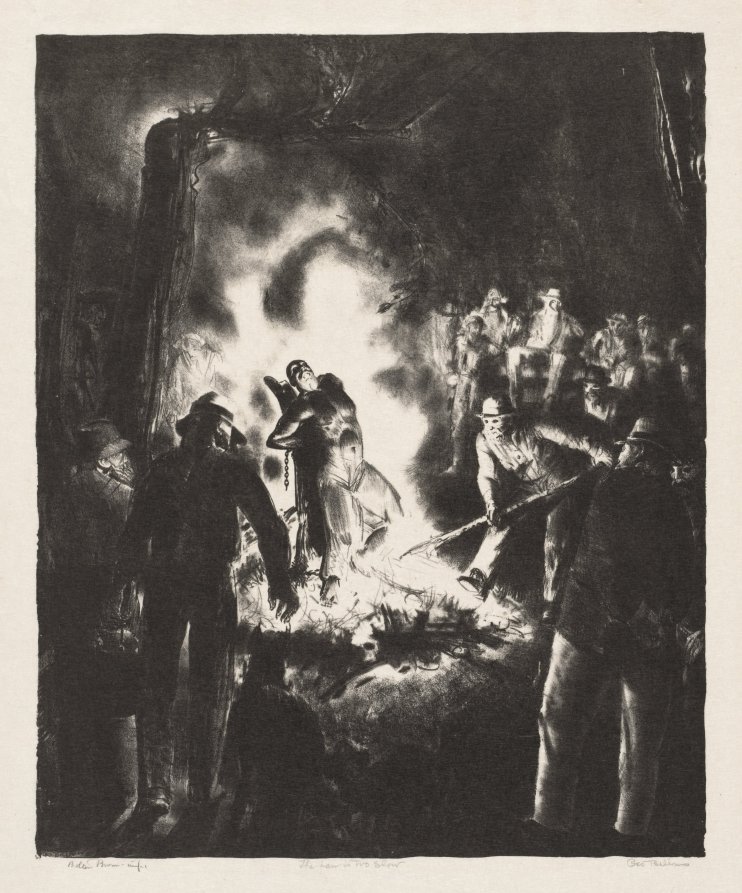
The Law is too Slow (1923) is in the Cleveland Museum of Art collection. The museum's creator attribution is George Bellows (American, 1882–1925).
The work and its context
The museum's open-access catalogue describes the work:
Bellows made this lithograph to illustrate "Nemesis," a fictitious anti-lynching story written by Mary Johnston and published in Century Magazine in May 1923. In the story, a Black man is accused of attacking and killing a white woman; he is then lynched by a mob of white men, all of whom subsequently fall upon misfortune themselves. Bellows portrays the gruesome lynching by highlighting the Black man's strong, illuminated body and surrounding it with an unfeeling mob of white men, some of whom watch as if at a sporting event. The glow of the fire highlights the lynched man's physical as well as internal strength, and visual resonances with Catholic imagery of deaths of saints imply the man's martyrdom. The title of the print may refer both to a twisted justification for lynching cited by racists during the Jim Crow era, as well as to the United States Congress's failure to pass anti-lynching laws.
Object facts
- Title: The Law is too Slow
- Date: 1923
- Creator attribution: George Bellows (American, 1882–1925)
- Culture: America
- Type: Print
- Technique: lithograph
- Collection: PR - Lithograph
- Department: Prints
- Accession number: 1936.588
Collection credit
Gift of Leonard C. Hanna Jr.
View the collection record
See the museum's photographs and full catalogue entry. Catalogue text is reproduced from the Cleveland Museum of Art's open-access data, with HTML formatting removed. This object and its supplied image are designated CC0.
Sources
More in Lifestyle
Keep reading