The lion disturbed by mice who eat the food trapped in his aging teeth, from a Tuti-nama (Tales of a Parrot): Fifteenth Night (c. 1560): Art, History and Details
The lion disturbed by mice who eat the food trapped in his aging teeth, from a Tuti-nama (Tales of a Parrot): Fifteenth Night at the Cleveland Museum of Art: c. 1560, gum tempera, ink, and gold on paper. Explore the work's context, creator
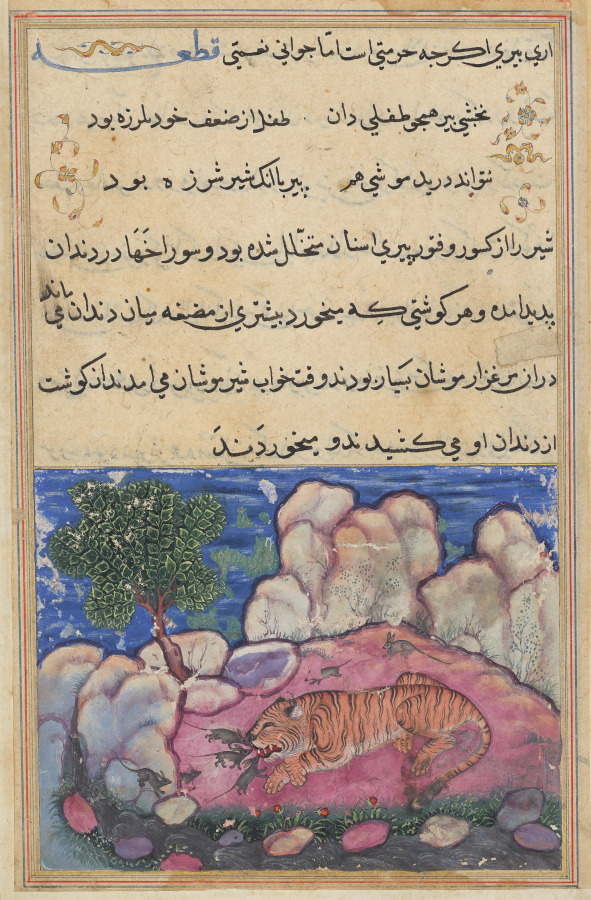
The lion disturbed by mice who eat the food trapped in his aging teeth, from a Tuti-nama (Tales of a Parrot): Fifteenth Night (c. 1560) is in the Cleveland Museum of Art collection.
The work and its context
The museum's open-access catalogue describes the work:
In a scene that was overpainted to suit the taste of the emperor Akbar for soft modeling and a naturalistic sky, a tiger lies in a pink clearing, while mice run around him to pick at his teeth. The artist has depicted a tiger instead of a lion, the two often being interchangeable in Indian art. In the story, the lion had grown old and suffered from cavities, into which his food would get stuck. Mice would come and feed on those morsels between his teeth and disturb his sleep.
Object facts
- Title: The lion disturbed by mice who eat the food trapped in his aging teeth, from a Tuti-nama (Tales of a Parrot): Fifteenth Night
- Date: c. 1560
- Culture: India, Mughal court, 16th century
- Type: Painting
- Technique: gum tempera, ink, and gold on paper
- Dimensions: Overall: 20.3 x 14 cm (8 x 5 1/2 in.); Painting only: 7.7 x 10.1 cm (3 1/16 x 4 in.)
- Collection: Indian Art
- Department: Indian and Southeast Asian Art
- Accession number: 1962.279.113.a
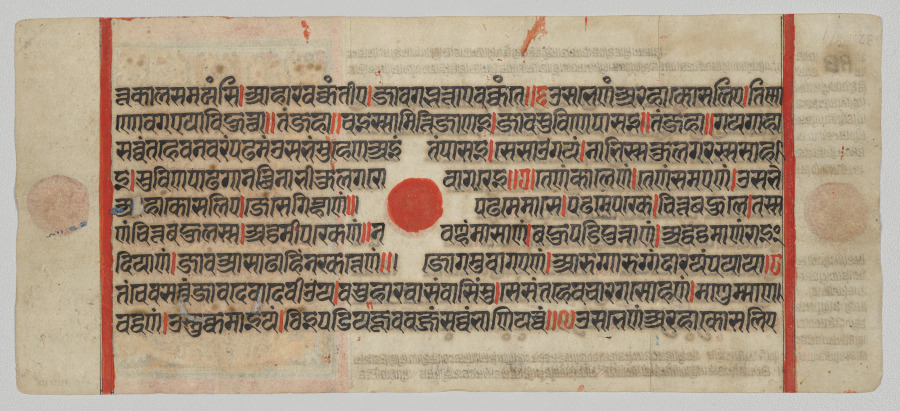
A detail from the museum
This story takes place in China
Collection credit
Gift of Mrs. A. Dean Perry
Further reading listed by the museum
- Chandra, Pramod, and Daniel J. Ehnbom. The Cleveland Tuti-Nama Manuscript and the Origins of Mughal Painting. Cleveland, OH: The Cleveland Museum of Art, 1976.
- Chandra, Pramod, and Daniel J. Ehnbom. The Cleveland Tuti-Nama Manuscript and the Origins of Mughal Painting. [Cleveland]: Cleveland Museum of Art, 1976.
- Nakhshabī, Z̤iyāʼ al-Dīn, and Muhammed Ahmed Simsar, translator and editor. Tales of a Parrot = The Cleveland Museum of Art's Ṭūṭīnāma. Cleveland, OH: The Museum, 1978.
View the collection record
See the museum's photographs and full catalogue entry. Catalogue text is reproduced from the Cleveland Museum of Art's open-access data, with HTML formatting removed. This object and its supplied image are designated CC0.
Sources
More in Lifestyle
Keep reading