The Magi Follow the Star (folio 34 recto), from a Mirror of Holiness (Mir’at al-quds) of Father Jerome Xavier (1602–4): Art, History and Details
The Magi Follow the Star (folio 34 recto), from a Mirror of Holiness (Mir’at al-quds) of Father Jerome Xavier at the Cleveland Museum of Art: 1602–4, Gum tempera, ink, and gold on paper. Explore the work's context, creator attribution and c
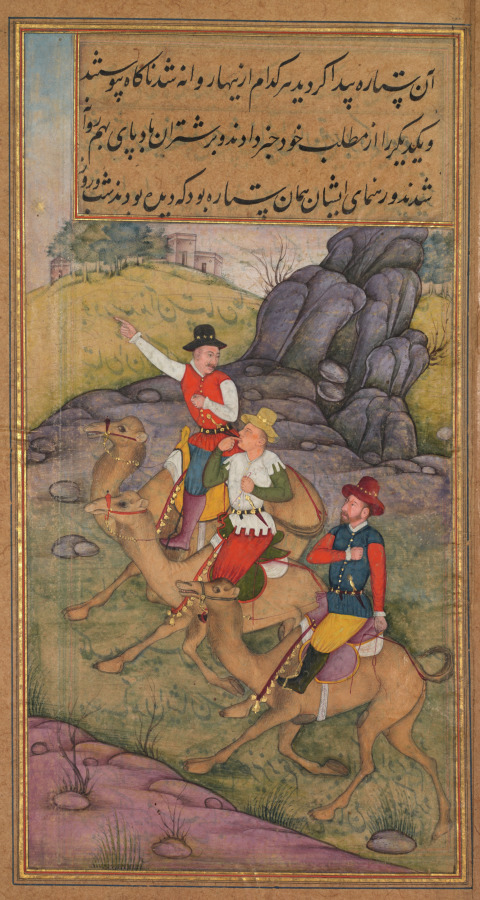
The Magi Follow the Star (folio 34 recto), from a Mirror of Holiness (Mir’at al-quds) of Father Jerome Xavier (1602–4) is in the Cleveland Museum of Art collection. The museum's creator attribution is Payag (Indian).
The work and its context
The museum's open-access catalogue describes the work:
One of the three kings points excitedly at the star at the upper left edge of the page, while another bites the finger of astonishment; the third holds his fist over his heart. They are all dressed like Portuguese merchants, but they ride camels associated with their homeland in Arabia, as specified in the text. The Westerners whom Mughals would have seen, besides priests, were mainly merchants from the Portuguese port of Goa on India’s western coast. They regularly visited Akbar to negotiate trade agreements, so they served as the primary visual model for all nonclerical Europeans. The artists who produced this manuscript worked for Akbar before joining Prince Salim at his rebel court in Allahabad.
Object facts
- Title: The Magi Follow the Star (folio 34 recto), from a Mirror of Holiness (Mir’at al-quds) of Father Jerome Xavier
- Date: 1602–4
- Creator attribution: Payag (Indian)
- Culture: Mughal India, Allahabad, made for Prince Salim (1569–1627)
- Type: Manuscript
- Technique: Gum tempera, ink, and gold on paper
- Dimensions: Sheet: 26.2 x 15.7 cm (10 5/16 x 6 3/16 in.); Image: 20.6 x 10.9 cm (8 1/8 x 4 5/16 in.)
- Collection: Indian Art
- Department: Indian and Southeast Asian Art
- Accession number: 2005.145.34.a
A detail from the museum
At the breakaway court of Prince Salim in Allahabad, high-quality materials were not as plentiful as in the imperial capital. The paper is brittle and has browned excessively, and the paint films are relatively thin; here the text from the verso shows through the lightly colored background.
Collection credit
John L. Severance Fund
Further reading listed by the museum
- Gommans, Jos J. L. The Unseen World: The Netherlands and India from 1550. [Amsterdam]: Rijks Museum: Uitgeverij Vantilt, 2018.
View the collection record
See the museum's photographs and full catalogue entry. Catalogue text is reproduced from the Cleveland Museum of Art's open-access data, with HTML formatting removed. This object and its supplied image are designated CC0.
Sources
More in Lifestyle
Keep reading