The merchant’s daughter gives birth to a son as a result of eating out of the box. The clever child recognizes the false gems from true, from a Tuti-nama (Tales of a Parrot): Twenty-third Night (c. 15
The merchant’s daughter gives birth to a son as a result of eating out of the box. The clever child recognizes the false gems from true, from a Tuti-nama (Tales of a Parrot): Twenty-third Night at the Cleveland Museum of Art: c. 1560, gum t
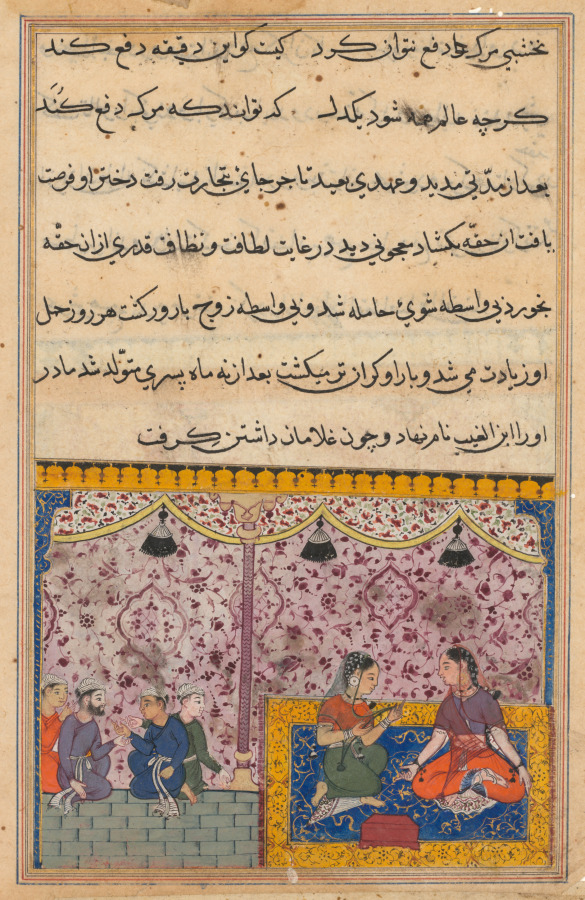
The merchant’s daughter gives birth to a son as a result of eating out of the box. The clever child recognizes the false gems from true, from a Tuti-nama (Tales of a Parrot): Twenty-third Night (c. 1560) is in the Cleveland Museum of Art collection.
The work and its context
The museum's open-access catalogue describes the work:
On the left, a group of merchants argue with a young boy over the veracity of their goods. The boy is a child of fate, miraculously born to a virgin after she ate the remains of a mysterious skull. The box containing the skull sits on the carpet between the virgin and her mother.
Object facts
- Title: The merchant’s daughter gives birth to a son as a result of eating out of the box. The clever child recognizes the false gems from true, from a Tuti-nama (Tales of a Parrot): Twenty-third Night
- Date: c. 1560
- Culture: Mughal India, court of Akbar (reigned 1556–1605)
- Type: Painting
- Technique: gum tempera, ink, and gold on paper
- Dimensions: Overall: 20.3 x 14 cm (8 x 5 1/2 in.); Painting only: 7.8 x 10.1 cm (3 1/16 x 4 in.)
- Collection: Indian Art
- Department: Indian and Southeast Asian Art
- Accession number: 1962.279.161.b
A detail from the museum
The child is named Ibn al-Ghaib meaning, “the son of an invisible man.”
Collection credit
Gift of Mrs. A. Dean Perry
Further reading listed by the museum
- Nakhshabī, Z̤iyāʼ al-Dīn, and Muhammed Ahmed Simsar. Tales of a Parrot = The Cleveland Museum of Art's Ṭūṭīnāma. Cleveland: The Museum, 1978.
- Chandra, Pramod, and Daniel J. Ehnbom. The Cleveland Tuti-Nama Manuscript and the Origins of Mughal Painting. [Cleveland]: Cleveland Museum of Art, 1976.
View the collection record
See the museum's photographs and full catalogue entry. Catalogue text is reproduced from the Cleveland Museum of Art's open-access data, with HTML formatting removed. This object and its supplied image are designated CC0.
Sources
More in Lifestyle
Keep reading