The merchant’s daughter meets the gardener, from a Tuti-nama (Tales of a Parrot): Twelfth Night (c. 1560): Art, History and Details
The merchant’s daughter meets the gardener, from a Tuti-nama (Tales of a Parrot): Twelfth Night at the Cleveland Museum of Art: c. 1560, gum tempera, ink, and gold on paper. Explore the work's context, creator attribution and collection his
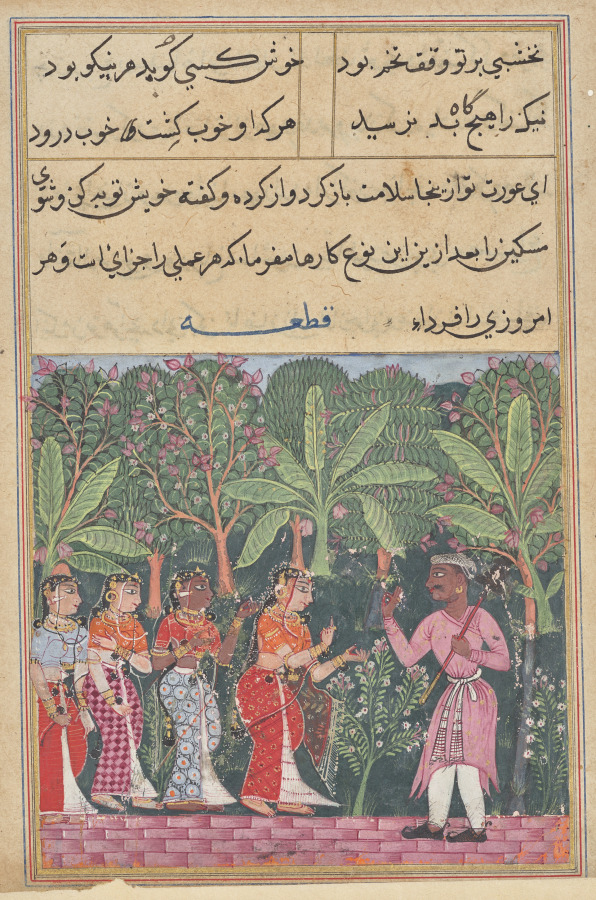
The merchant’s daughter meets the gardener, from a Tuti-nama (Tales of a Parrot): Twelfth Night (c. 1560) is in the Cleveland Museum of Art collection.
The work and its context
The museum's open-access catalogue describes the work:
Persian books are read from right to left. One artist illustrated the three scenes from one of the 52 stories of the Tuti-nama, retaining many pre-Mughal traits. Trees stand out as bold shapes, and figures are arranged in a single register, or horizontal spatial band, and have angular and expressive gestures. The figures of the women are closely related to pre-Mughal types, shown always in profile and wearing garments that stand stiffly and sharply out before them. In leaves from the Tuti-nama, Mughal artists adapted the colors, compositions, and figure types of the earlier style.
Object facts
- Title: The merchant’s daughter meets the gardener, from a Tuti-nama (Tales of a Parrot): Twelfth Night
- Date: c. 1560
- Culture: Mughal India, court of Akbar (reigned 1556–1605)
- Type: Painting
- Technique: gum tempera, ink, and gold on paper
- Dimensions: Overall: 20.3 x 14 cm (8 x 5 1/2 in.); Painting only: 9.8 x 10.1 cm (3 7/8 x 4 in.)
- Collection: Indian Art
- Department: Indian and Southeast Asian Art
- Accession number: 1962.279.100.b
A detail from the museum
In the time since their first meeting, the gardener has become an ascetic.
Collection credit
Gift of Mrs. A. Dean Perry
Further reading listed by the museum
- Chandra, Pramod, and Daniel J. Ehnbom. The Cleveland Tuti-Nama Manuscript and the Origins of Mughal Painting. [Cleveland]: Cleveland Museum of Art, 1976.
- Seyller, John. “Overpainting in the Cleveland T̤ūtīnāma.” Artibus Asiae 52, no. 3/4 (1992): 283-318.
View the collection record
See the museum's photographs and full catalogue entry. Catalogue text is reproduced from the Cleveland Museum of Art's open-access data, with HTML formatting removed. This object and its supplied image are designated CC0.
Sources
More in Lifestyle
Keep reading