The New-born Buddha (400s CE): Art, History and Details
The New-born Buddha at the Cleveland Museum of Art: 400s CE, gilt bronze with inlays of blue glass and turquoise. Explore the work's context, creator attribution and collection history.
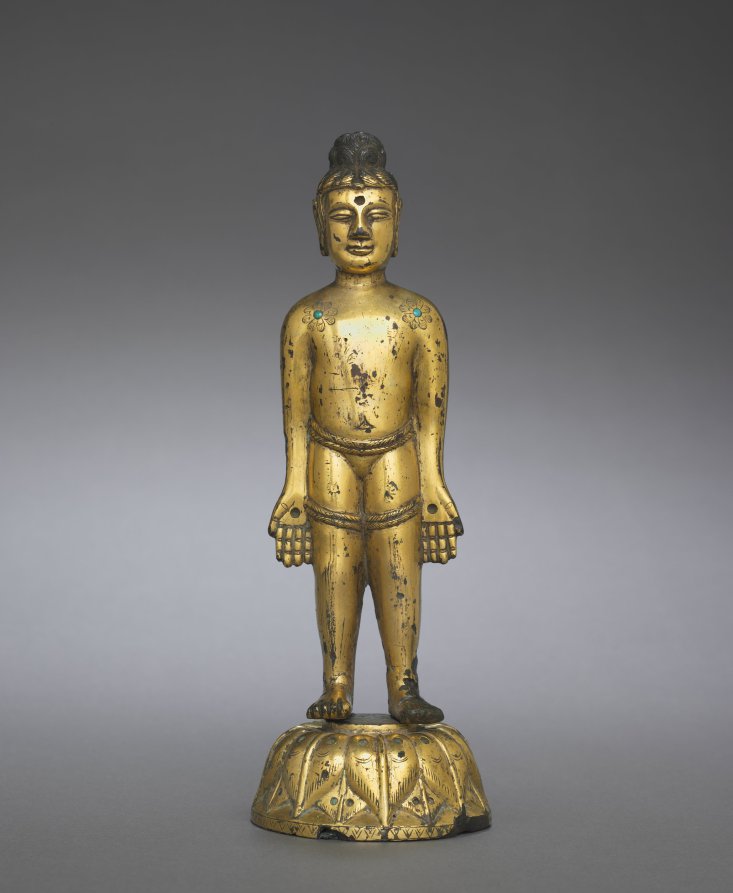
The New-born Buddha (400s CE) is in the Cleveland Museum of Art collection.
The work and its context
The museum's open-access catalogue describes the work:
This image of the newborn Buddha is rare and unusual. The common type represents him taking seven steps while proclaiming "I am supreme in the Universe." Here, he is represented as being bathed by the nine Nagas, with both hands down.
Object facts
- Title: The New-born Buddha
- Date: 400s CE
- Culture: China, Northern Wei dynasty (386-534)
- Type: Sculpture
- Technique: gilt bronze with inlays of blue glass and turquoise
- Dimensions: Overall: 19.4 cm (7 5/8 in.); Diameter of base: 6.8 cm (2 11/16 in.); Base: 3.1 cm (1 1/4 in.)
- Collection: China - Southern Dynasties
- Department: Chinese Art
- Accession number: 1955.46
A detail from the museum
The tang on the back of the Buddha's head shows that it originally had a halo.
Collection credit
Purchase from the J. H. Wade Fund
Further reading listed by the museum
- Lee, Sherman E. “The Golden Image of the New-Born Buddha.” Artibus Asiae 18, no. 3/4 (1955): 225–237.
- Lee, Sherman. "The New-Born Buddha." The Bulletin of the Cleveland Museum of Art 43, no. 9 (November 1956): 202–204.
- The Cleveland Museum of Art. The Cleveland Museum of Art Handbook. Cleveland, OH: The Cleveland Museum of Art, 1958.
View the collection record
See the museum's photographs and full catalogue entry. Catalogue text is reproduced from the Cleveland Museum of Art's open-access data, with HTML formatting removed. This object and its supplied image are designated CC0.
Sources
More in Lifestyle
Keep reading