The old man eats of the fruit of the Tree of Life, but drops dead, from a Tuti-nama (Tales of a Parrot): Ninth Night (c. 1560): Art, History and Details
The old man eats of the fruit of the Tree of Life, but drops dead, from a Tuti-nama (Tales of a Parrot): Ninth Night at the Cleveland Museum of Art: c. 1560, gum tempera, ink, and gold on paper. Explore the work's context, creator attributi
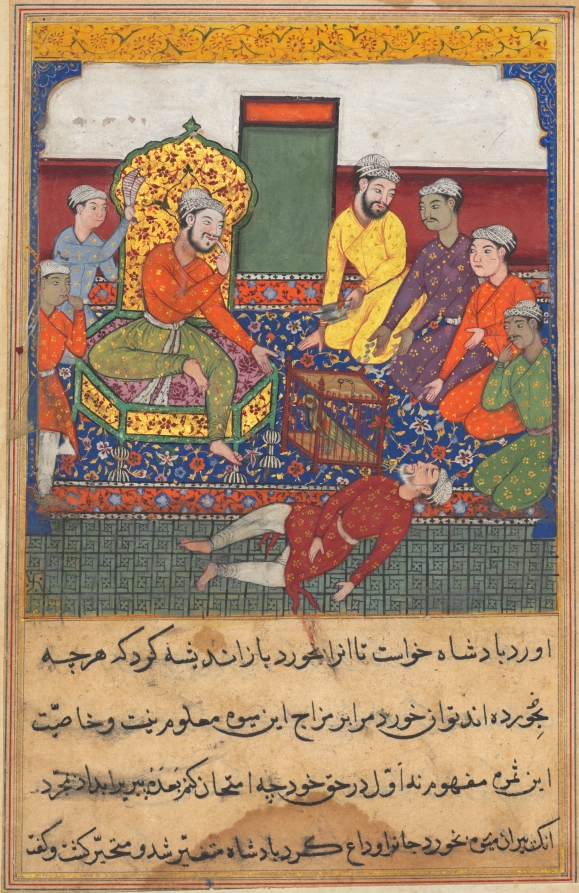
The old man eats of the fruit of the Tree of Life, but drops dead, from a Tuti-nama (Tales of a Parrot): Ninth Night (c. 1560) is in the Cleveland Museum of Art collection. The museum's creator attribution is Lalu (Indian, active mid-1500s).
The work and its context
The museum's open-access catalogue describes the work:
The enthroned king stares in amazement at the body of the old man. The parrot, who brought the king the fruit, sits in a cage at the center of the room. Believing the parrot to be a traitor, the king orders his execution. However, unbeknownst to the king, the fruit was actually poisoned by the bite of a venomous snake.
Object facts
- Title: The old man eats of the fruit of the Tree of Life, but drops dead, from a Tuti-nama (Tales of a Parrot): Ninth Night
- Date: c. 1560
- Creator attribution: Lalu (Indian, active mid-1500s)
- Culture: Mughal India, court of Akbar (reigned 1556–1605)
- Type: Painting
- Technique: gum tempera, ink, and gold on paper
- Dimensions: Painting only: 11.4 x 10.2 cm (4 1/2 x 4 in.); Overall: 20.1 x 14.3 cm (7 15/16 x 5 5/8 in.)
- Collection: Indian Art
- Department: Indian and Southeast Asian Art
- Accession number: 1962.279.78.a
A detail from the museum
The gesture of the index finger touching the mouth indicates shock, awe, or bewilderment.
Collection credit
Gift of Mrs. A. Dean Perry
Further reading listed by the museum
- Chandra, Pramod, and Daniel J. Ehnbom. The Cleveland Tuti-Nama Manuscript and the Origins of Mughal Painting. [Cleveland]: Cleveland Museum of Art, 1976.
- Seyller, John. “Overpainting in the Cleveland T̤ūtīnāma.” Artibus Asiae 52, no. 3/4 (1992): 283-318.
View the collection record
See the museum's photographs and full catalogue entry. Catalogue text is reproduced from the Cleveland Museum of Art's open-access data, with HTML formatting removed. This object and its supplied image are designated CC0.
Sources
More in Lifestyle
Keep reading