The Parrot Addresses Khujasta at the Beginning of the Eleventh Night, from a Tuti-nama (Tales of a Parrot) (c. 1560): Art, History and Details
The Parrot Addresses Khujasta at the Beginning of the Eleventh Night, from a Tuti-nama (Tales of a Parrot) at the Cleveland Museum of Art: c. 1560, gum tempera, ink, and gold on paper. Explore the work's context, creator attribution and col
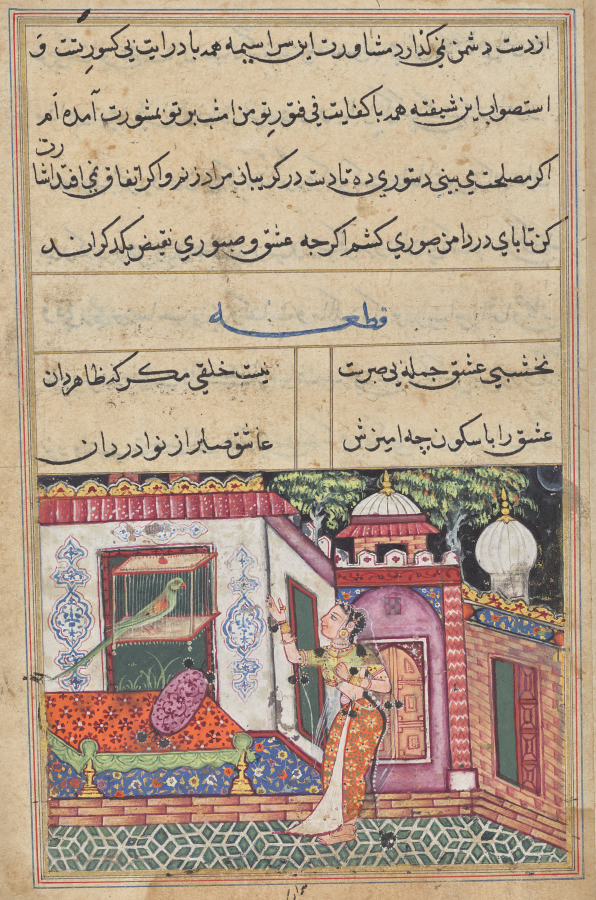
The Parrot Addresses Khujasta at the Beginning of the Eleventh Night, from a Tuti-nama (Tales of a Parrot) (c. 1560) is in the Cleveland Museum of Art collection. The museum's creator attribution is Banavari 2 (Indian, active 1550s-1590s).
The work and its context
The museum's open-access catalogue describes the work:
When the lover of the ocean—the sun—entered his place of retirement in the west and the beloved of the stars— the moon—came out of the bride’s apartment in the east, Khujasta with eyes wet like the sea and tears like brilliant gems went to Tuti to ask his permission to leave. . . . Eleven days and nights have come and gone since Khujasta fell for a local prince. Each night, having prepared herself for a lovers’ rendezvous, her husband’s pet parrot has beguiled her into staying up all night listening to his stories at home. On this night, he tells her that it is good that she has sought his advice on going out, for “[Anyone] who seeks counsel in regard to his affairs and secures advice on his problems will see exactly what the Brahman saw.” Unable to stem her curiosity, she asks the parrot what he saw.
Object facts
- Title: The Parrot Addresses Khujasta at the Beginning of the Eleventh Night, from a Tuti-nama (Tales of a Parrot)
- Date: c. 1560
- Creator attribution: Banavari 2 (Indian, active 1550s-1590s)
- Culture: Mughal India, court of Akbar (reigned 1556–1605)
- Type: Painting
- Technique: gum tempera, ink, and gold on paper
- Dimensions: Painting only: 7.7 x 10.1 cm (3 1/16 x 4 in.); Overall: 20.1 x 13.6 cm (7 15/16 x 5 3/8 in.)
- Collection: Indian Art
- Department: Indian and Southeast Asian Art
- Accession number: 1962.279.87.a
A detail from the museum
Two painters named Banavari are known to have been active during the Akbar period.
Collection credit
Gift of Mrs. A. Dean Perry
Further reading listed by the museum
- Chandra, Pramod, and Daniel J. Ehnbom. The Cleveland Tuti-Nama Manuscript and the Origins of Mughal Painting. [Cleveland]: Cleveland Museum of Art, 1976.
- Chandra, Pramod, and Daniel J. Ehnbom. The Cleveland Tuti-Nama Manuscript and the Origins of Mughal Painting. [Cleveland]: Cleveland Museum of Art, 1976.
- Seyller, John. “Overpainting in the Cleveland T̤ūtīnāma.” Artibus Asiae 52, no. 3/4 (1992): 283-318.
View the collection record
See the museum's photographs and full catalogue entry. Catalogue text is reproduced from the Cleveland Museum of Art's open-access data, with HTML formatting removed. This object and its supplied image are designated CC0.
Sources
More in Lifestyle
Keep reading