The Parrot Addresses Khujasta at the Beginning of the Twelfth Night, from a Tuti-nama (Tales of a Parrot) (c. 1560): Art, History and Details
The Parrot Addresses Khujasta at the Beginning of the Twelfth Night, from a Tuti-nama (Tales of a Parrot) at the Cleveland Museum of Art: c. 1560, gum tempera, ink, and gold on paper. Explore the work's context, creator attribution and coll
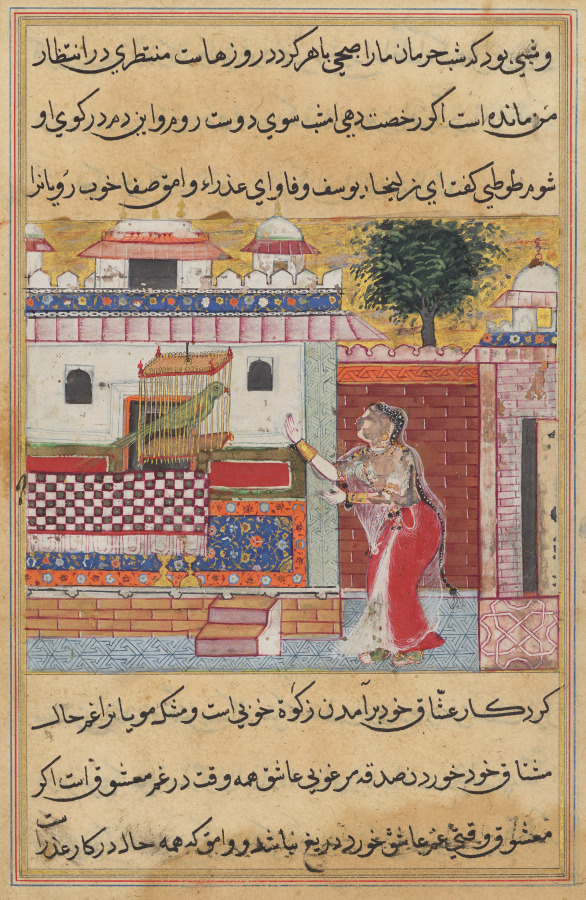
The Parrot Addresses Khujasta at the Beginning of the Twelfth Night, from a Tuti-nama (Tales of a Parrot) (c. 1560) is in the Cleveland Museum of Art collection. The museum's creator attribution is Tara 1 (Indian, active 1550s-1590s).
The work and its context
The museum's open-access catalogue describes the work:
Every night for 52 nights the sly domesticated parrot encourages his master's wife Khujasta to meet her lover under cover of darkness. Just before she leaves, he mentions a topic from a tantalizing tale; she becomes so curious that she cannot go out before hearing the whole story. By the time the story ends, dawn breaks, and it is too late for her to go out unnoticed. The gold sky and geometric tile patterns are derived from Persian sources while Khujasta's figure shown in profile and style of dress are purely Indian. The artist has chosen to tilt the carpet up in defiance of realistic perspective to show off the fine arabesque motif. The checkered bedspread calls attention to the empty bed and Khujasta's longing to be with her lover.
Object facts
- Title: The Parrot Addresses Khujasta at the Beginning of the Twelfth Night, from a Tuti-nama (Tales of a Parrot)
- Date: c. 1560
- Creator attribution: Tara 1 (Indian, active 1550s-1590s)
- Culture: Mughal India, court of Akbar (reigned 1556–1605)
- Type: Painting
- Technique: gum tempera, ink, and gold on paper
- Dimensions: Overall: 20.3 x 14 cm (8 x 5 1/2 in.); Painting only: 9.1 x 10.3 cm (3 9/16 x 4 1/16 in.)
- Collection: Indian Art
- Department: Indian and Southeast Asian Art
- Accession number: 1962.279.95.a
A detail from the museum
The gauzy fabric that Khujasta wears over her sari is called an odhani.
Collection credit
Gift of Mrs. A. Dean Perry
Further reading listed by the museum
- Chandra, Pramod, and Daniel J. Ehnbom. The Cleveland Tuti-Nama Manuscript and the Origins of Mughal Painting. [Cleveland]: Cleveland Museum of Art, 1976.
- Seyller, John. “Overpainting in the Cleveland T̤ūtīnāma.” Artibus Asiae 52, no. 3/4 (1992): 283-318.
View the collection record
See the museum's photographs and full catalogue entry. Catalogue text is reproduced from the Cleveland Museum of Art's open-access data, with HTML formatting removed. This object and its supplied image are designated CC0.
Sources
More in Lifestyle
Keep reading