The Parrot Addresses Khujasta at the Beginning of the Twenty-second Night, from a Tuti-nama (Tales of a Parrot) (c. 1560): Art, History and Details
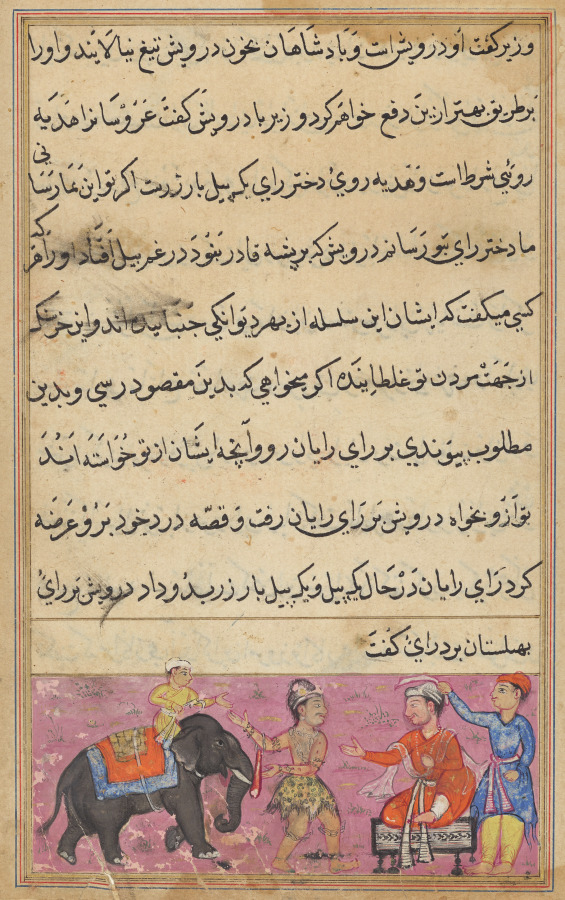
The Parrot Addresses Khujasta at the Beginning of the Twenty-second Night, from a Tuti-nama (Tales of a Parrot) at the Cleveland Museum of Art: c. 1560, gum tempera, ink, and gold on paper. Explore the work's context, creator attribution an
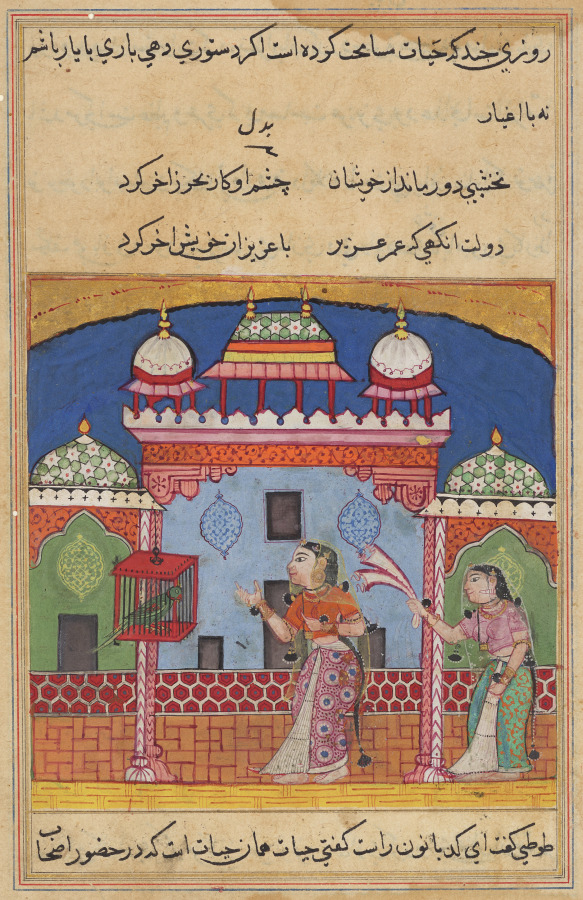
The Parrot Addresses Khujasta at the Beginning of the Twenty-second Night, from a Tuti-nama (Tales of a Parrot) (c. 1560) is in the Cleveland Museum of Art collection.
The work and its context
The museum's open-access catalogue describes the work:
On the 22nd night after her husband’s departure, the parrot advises his mistress Kujastha that when she meets her lover that night she should use her best judgment and manners and not allow herself to be laughed at like the wife of the amir, a local ruler. When Khujasta asked about what happened to her, the parrot related a story about the amir, his jester, and their unfaithful wives. This artist continued to use flat planes of colors and patterns characteristic of Indian painting before the Mughals. Experimentation with techniques to indicate depth and spatial recession––a new trend early in the reign of Akbar––can be seen in the tilted planes of the birdcage and the shading at the edges of the doorways.
Object facts
- Title: The Parrot Addresses Khujasta at the Beginning of the Twenty-second Night, from a Tuti-nama (Tales of a Parrot)
- Date: c. 1560
- Culture: Mughal India, court of Akbar (reigned 1556–1605)
- Type: Painting
- Technique: gum tempera, ink, and gold on paper
- Dimensions: Overall: 20.3 x 14 cm (8 x 5 1/2 in.); Painting only: 10.1 x 9.8 cm (4 x 3 7/8 in.)
- Collection: Indian Art
- Department: Indian and Southeast Asian Art
- Accession number: 1962.279.154.a
A detail from the museum
The parrot’s story is set in Kerman, a province of southeast Iran.
Collection credit
Gift of Mrs. A. Dean Perry
Further reading listed by the museum
- Chandra, Pramod, and Daniel J. Ehnbom. The Cleveland Tuti-Nama Manuscript and the Origins of Mughal Painting. [Cleveland]: Cleveland Museum of Art, 1976.
- Seyller, John. “Overpainting in the Cleveland T̤ūtīnāma.” Artibus Asiae 52, no. 3/4 (1992): 283-318.
View the collection record
See the museum's photographs and full catalogue entry. Catalogue text is reproduced from the Cleveland Museum of Art's open-access data, with HTML formatting removed. This object and its supplied image are designated CC0.
Sources
More in Lifestyle
Keep reading
Related stories