The prince and Nikfal are joined by Khalis and the Mukhlis who are the grateful snake and frog in human form, from a Tuti-nama (Tales of a Parrot): Eighteenth Night (c. 1560): Art, History and Details
The prince and Nikfal are joined by Khalis and the Mukhlis who are the grateful snake and frog in human form, from a Tuti-nama (Tales of a Parrot): Eighteenth Night at the Cleveland Museum of Art: c. 1560, gum tempera, ink, and gold on pape
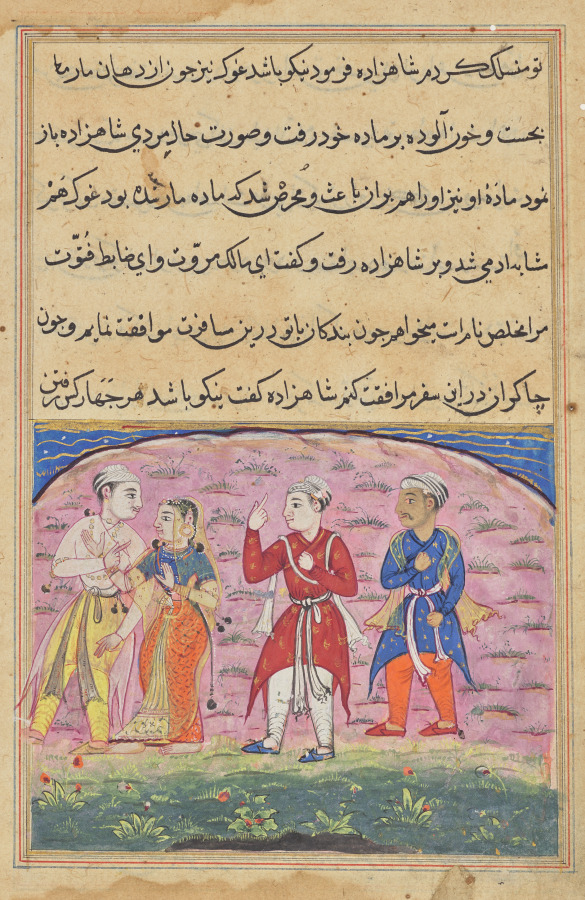
The prince and Nikfal are joined by Khalis and the Mukhlis who are the grateful snake and frog in human form, from a Tuti-nama (Tales of a Parrot): Eighteenth Night (c. 1560) is in the Cleveland Museum of Art collection.
The work and its context
The museum's open-access catalogue describes the work:
The prince, wearing yellow pants, with Nikfal (Good Fortune) by his side, looks back to see two men approaching. They introduce themselves as the cobra, whom the prince fed from his own flesh, and the frog, whose life he saved. They took on human forms and pledged to be his servants until they have returned the favor of his kindness. At the bottom of the page is the edge of a pool painted in silver paint that has tarnished black. Grass and poppies grow on its banks. The otherwise arid landscape has been painted pink with sparse grassy tufts.
Object facts
- Title: The prince and Nikfal are joined by Khalis and the Mukhlis who are the grateful snake and frog in human form, from a Tuti-nama (Tales of a Parrot): Eighteenth Night
- Date: c. 1560
- Culture: Mughal India, court of Akbar (reigned 1556–1605)
- Type: Painting
- Technique: gum tempera, ink, and gold on paper
- Dimensions: Overall: 20.3 x 14 cm (8 x 5 1/2 in.); Painting only: 8.2 x 10 cm (3 1/4 x 3 15/16 in.)
- Collection: Indian Art
- Department: Indian and Southeast Asian Art
- Accession number: 1962.279.134.b
A detail from the museum
The men wear Central Asian pants and tunic, while the woman wears Indian dress.
Collection credit
Gift of Mrs. A. Dean Perry
Further reading listed by the museum
- Seyller, John. “Overpainting in the Cleveland T̤ūtīnāma.” Artibus Asiae 52, no. 3/4 (1992): 283-318.
View the collection record
See the museum's photographs and full catalogue entry. Catalogue text is reproduced from the Cleveland Museum of Art's open-access data, with HTML formatting removed. This object and its supplied image are designated CC0.
Sources
More in Lifestyle
Keep reading


