The Prophet Joel (early 1570s): Art, History and Details
The Prophet Joel at the Cleveland Museum of Art: early 1570s, engraving. Explore the work's context, creator attribution and collection history.
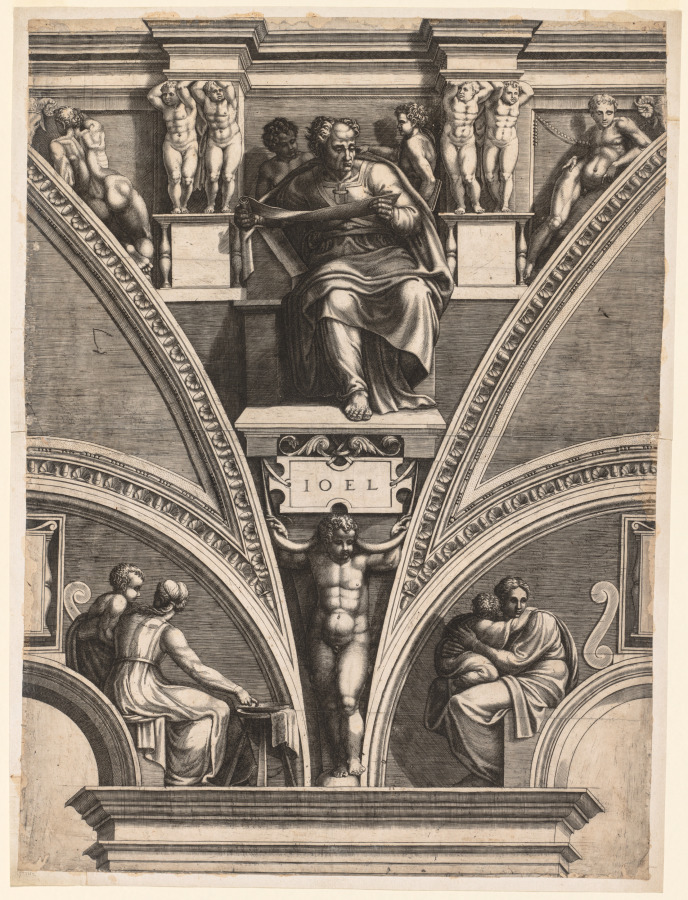
The Prophet Joel (early 1570s) is in the Cleveland Museum of Art collection. The museum's creator attribution is Giorgio Ghisi (Italian, 1520–1582); Michelangelo Buonarroti (Italian, 1475–1564).
The work and its context
The museum's open-access catalogue describes the work:
During the 1500s Michelangelo’s Sistine Chapel ceiling was rarely open to the public and thus for the most part inaccessible. Artists, however, were generally allowed to visit the chapel to study and make drawings from the paintings. Giorgio Ghisi did so in the 1540s and created engravings of six of the chapel’s prophets and sybils. His Prophet Joel accurately reproduces the pose, costume elements, and architectural detail of the figure in a voluminous engraving technique, with dramatic darks and lights that evoke the three-dimensional forms of sculpture. Engravings such as this spread Michelangelo’s inventions throughout Europe, but in pieces: one still had to visit the chapel to see the whole composition.
Object facts
- Title: The Prophet Joel
- Date: early 1570s
- Creator attribution: Giorgio Ghisi (Italian, 1520–1582); Michelangelo Buonarroti (Italian, 1475–1564)
- Culture: Italy
- Type: Print
- Technique: engraving
- Dimensions: Sheet: 55.9 x 41.5 cm (22 x 16 5/16 in.); Secondary Support: 57.7 x 42.9 cm (22 11/16 x 16 7/8 in.)
- Collection: PR - Engraving
- Department: Prints
- Accession number: 1990.58
Collection credit
Gift of Jane and Robert Lewis in memory of Harold Fallon
Further reading listed by the museum
- Turner, Evan H. “Acquisitions: 1990.” The Bulletin of the Cleveland Museum of Art 78, no. 2 (February 1991): 30–45.
View the collection record
See the museum's photographs and full catalogue entry. Catalogue text is reproduced from the Cleveland Museum of Art's open-access data, with HTML formatting removed. This object and its supplied image are designated CC0.
Sources
More in Lifestyle
Keep reading