The queen of Rum watches the peahen prefer to burn rather than abandon her eggs while the peacock flees the nest, from a Tuti-nama (Tales of a Parrot): Thirty-ninth Night (c. 1560): Art, History and D
The queen of Rum watches the peahen prefer to burn rather than abandon her eggs while the peacock flees the nest, from a Tuti-nama (Tales of a Parrot): Thirty-ninth Night at the Cleveland Museum of Art: c. 1560, gum tempera, ink, and gold o
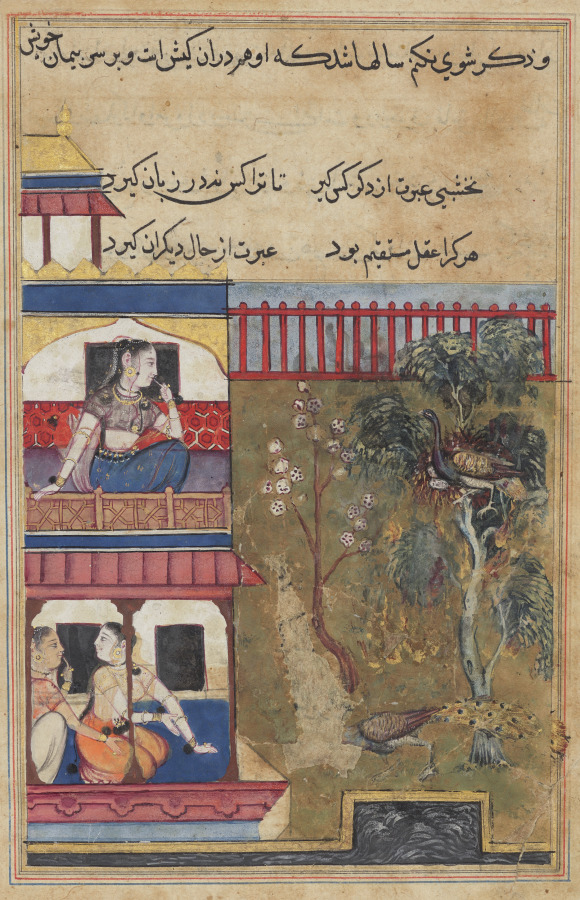
The queen of Rum watches the peahen prefer to burn rather than abandon her eggs while the peacock flees the nest, from a Tuti-nama (Tales of a Parrot): Thirty-ninth Night (c. 1560) is in the Cleveland Museum of Art collection.
The work and its context
The museum's open-access catalogue describes the work:
The queen of Rum sits in the upper balcony of her palace watching the fire in her garden with shock. Two female attendants observe the action from the room below. The cowardliness of the peacock in the face of danger convinced the queen of the disloyalty of men. As a result, she vowed to never marry.
Object facts
- Title: The queen of Rum watches the peahen prefer to burn rather than abandon her eggs while the peacock flees the nest, from a Tuti-nama (Tales of a Parrot): Thirty-ninth Night
- Date: c. 1560
- Culture: Mughal India, court of Akbar (reigned 1556–1605)
- Type: Painting
- Technique: gum tempera, ink, and gold on paper
- Dimensions: Overall: 20.3 x 14 cm (8 x 5 1/2 in.); Painting only: 16 x 10.3 cm (6 5/16 x 4 1/16 in.)
- Collection: Indian Art
- Department: Indian and Southeast Asian Art
- Accession number: 1962.279.254.b
A detail from the museum
Rum is the Arabic name of Rome and once designated the Byzantine Empire.
Collection credit
Gift of Mrs. A. Dean Perry
Further reading listed by the museum
- Chandra, Pramod, and Daniel J. Ehnbom. The Cleveland Tuti-Nama Manuscript and the Origins of Mughal Painting. [Cleveland]: Cleveland Museum of Art, 1976.
- Nakhshabī, Z̤iyāʼ al-Dīn, and Muhammed Ahmed Simsar. Tales of a Parrot = The Cleveland Museum of Art's Ṭūṭīnāma. Cleveland: The Museum, 1978.
View the collection record
See the museum's photographs and full catalogue entry. Catalogue text is reproduced from the Cleveland Museum of Art's open-access data, with HTML formatting removed. This object and its supplied image are designated CC0.
Sources
More in Lifestyle
Keep reading