The Race Track (Death on a Pale Horse) (c. 1896–1908): Art, History and Details
The Race Track (Death on a Pale Horse) at the Cleveland Museum of Art: c. 1896–1908, oil on canvas. Explore the work's context, creator attribution and collection history.
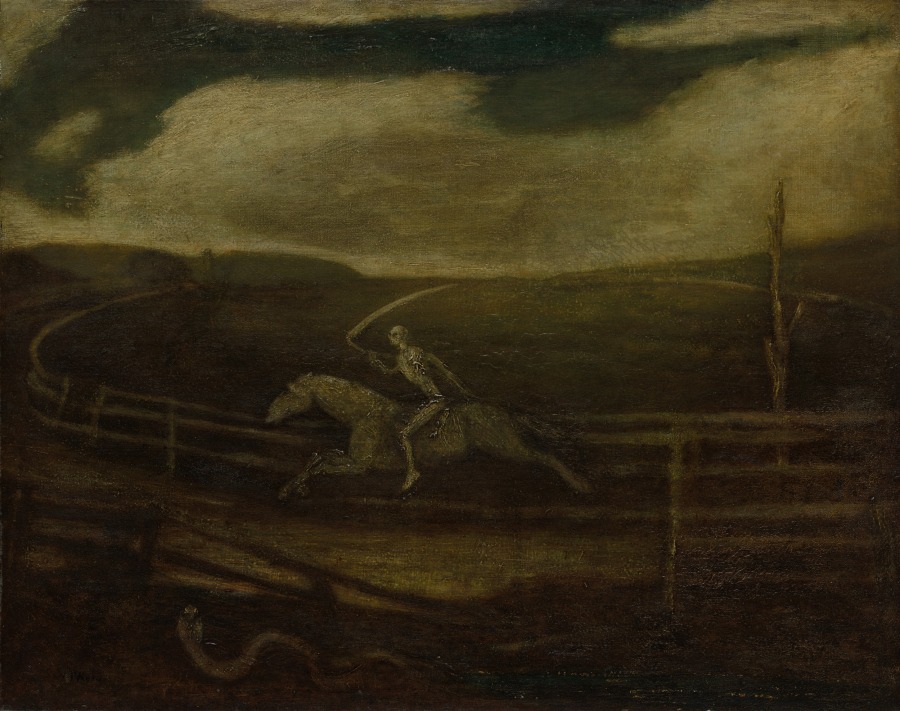
The Race Track (Death on a Pale Horse) (c. 1896–1908) is in the Cleveland Museum of Art collection. The museum's creator attribution is Albert Pinkham Ryder (American, 1847–1917).
The work and its context
The museum's open-access catalogue describes the work:
Ryder’s subject was inspired by a horse race that took place in New York during 1888. One of the artist’s friends wagered $500 on the race and then died by suicide after the horse lost. Medieval symbolism infuses the composition: death appears as a skeleton on horseback holding a scythe with which it cuts down the living, while a snake—a sign of temptation and evil—slithers in the foreground. An intense man, Ryder worked on the painting for several years and was deeply reluctant to part with it.
Object facts
- Title: The Race Track (Death on a Pale Horse)
- Date: c. 1896–1908
- Creator attribution: Albert Pinkham Ryder (American, 1847–1917)
- Culture: America
- Type: Painting
- Technique: oil on canvas
- Dimensions: Framed: 84.5 x 102 x 6.5 cm (33 1/4 x 40 3/16 x 2 9/16 in.); Unframed: 70.5 x 90 cm (27 3/4 x 35 7/16 in.)
- Collection: American - Painting
- Department: American Painting and Sculpture
- Accession number: 1928.8
A detail from the museum
Counterclockwise horse racing in the United States was not standardized until the 1920s.
Collection credit
Purchase from the J. H. Wade Fund
Further reading listed by the museum
- The Art Digest (Feb. 1, 1928):2.
- The Art Digest (Feb. 1, 1928): 2.
- Zachary Ross, “Linked by Nervousness: Albert Pinkham Ryder and Dr. Albert T. Sanden,” American Art 17.2 (Summer 2003): 86-96.
View the collection record
See the museum's photographs and full catalogue entry. Catalogue text is reproduced from the Cleveland Museum of Art's open-access data, with HTML formatting removed. This object and its supplied image are designated CC0.
Sources
More in Lifestyle
Keep reading