The rejuvenated old man and the daughter of the king of the jinns take leave of the King of Kings, from a Tuti-nama (Tales of a Parrot): Seventh Night (c. 1560): Art, History and Details
The rejuvenated old man and the daughter of the king of the jinns take leave of the King of Kings, from a Tuti-nama (Tales of a Parrot): Seventh Night at the Cleveland Museum of Art: c. 1560, gum tempera, ink, and gold on paper. Explore the
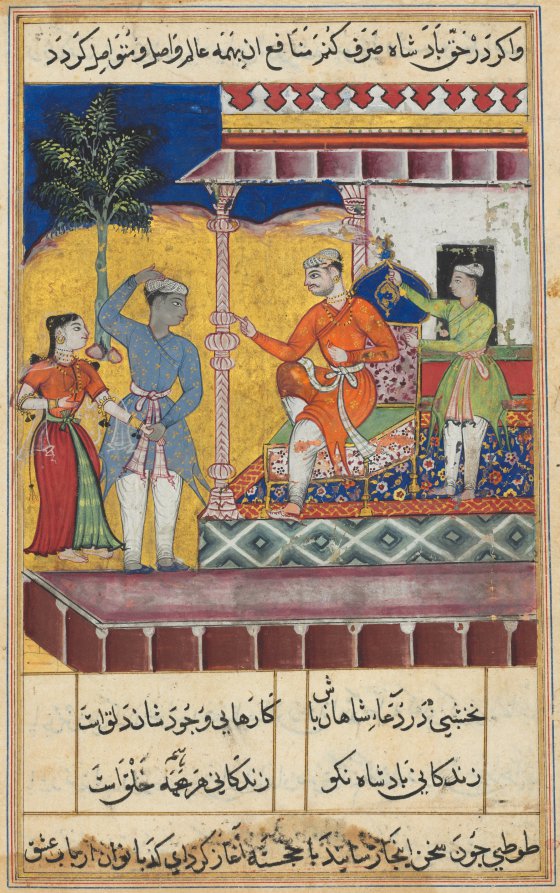
The rejuvenated old man and the daughter of the king of the jinns take leave of the King of Kings, from a Tuti-nama (Tales of a Parrot): Seventh Night (c. 1560) is in the Cleveland Museum of Art collection.
The work and its context
The museum's open-access catalogue describes the work:
The artist who painted the first two scenes rendered the pit as a structure made of bricks. Peering over the edge is a Brahmin, a member of the Hindu priest class, wearing white. In the first painting he holds the bracelets given to him by the jinn princess to pay off his gambling debts; in the second he holds a text. In the pit, the jinn princess has been waiting for 70 years for her beloved to find the courage to pass through the cauldron of boiling oil in order to become purified enough to be with her––a jinn, who is a being of light, like a genie. Hearing of this predicament from the Brahmin, the King of Kings, wearing orange, provided a salve that protects the wearer from the harm of the hot oil, so the old man could safely pass through the boiling cauldron, which restored his youth. The artist Banavari, whose name is inscribed on the margin of the third page, went on to become a prominent artist in Akbar’s atelier. This painting may be the earliest surviving example of his work.
Object facts
- Title: The rejuvenated old man and the daughter of the king of the jinns take leave of the King of Kings, from a Tuti-nama (Tales of a Parrot): Seventh Night
- Date: c. 1560
- Culture: Mughal India, court of Akbar (reigned 1556–1605)
- Type: Painting
- Technique: gum tempera, ink, and gold on paper
- Dimensions: Overall: 20.3 x 14 cm (8 x 5 1/2 in.); Painting only: 11.3 x 10.1 cm (4 7/16 x 4 in.)
- Collection: Indian Art
- Department: Indian and Southeast Asian Art
- Accession number: 1962.279.50.b
A detail from the museum
The old man emerges from the boiling oil eighteen years old and beardless.
Collection credit
Gift of Mrs. A. Dean Perry
Further reading listed by the museum
- Chandra, Pramod, and Daniel J. Ehnbom. The Cleveland Tuti-Nama Manuscript and the Origins of Mughal Painting. [Cleveland]: Cleveland Museum of Art, 1976.
- Chandra, Pramod, and Daniel J. Ehnbom. The Cleveland Tuti-Nama Manuscript and the Origins of Mughal Painting. Cleveland, OH: The Cleveland Museum of Art, 1976.
- Chandra, Pramod, and Daniel J. Ehnbom. The Cleveland Tuti-Nama Manuscript and the Origins of Mughal Painting. [Cleveland]: Cleveland Museum of Art, 1976.
View the collection record
See the museum's photographs and full catalogue entry. Catalogue text is reproduced from the Cleveland Museum of Art's open-access data, with HTML formatting removed. This object and its supplied image are designated CC0.
Sources
More in Lifestyle
Keep reading