The soldier receives a garland of roses from his wife which will remain fresh as long as she is faithful, from a Tuti-nama (Tales of a Parrot): Fourth Night (c. 1560): Art, History and Details
The soldier receives a garland of roses from his wife which will remain fresh as long as she is faithful, from a Tuti-nama (Tales of a Parrot): Fourth Night at the Cleveland Museum of Art: c. 1560, gum tempera, ink, and gold on paper. Explo
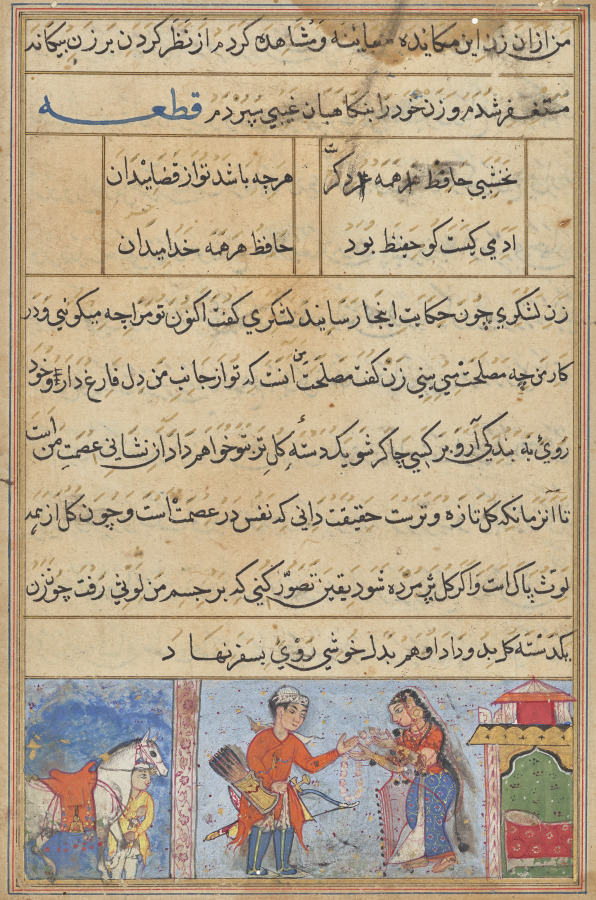
The soldier receives a garland of roses from his wife which will remain fresh as long as she is faithful, from a Tuti-nama (Tales of a Parrot): Fourth Night (c. 1560) is in the Cleveland Museum of Art collection.
The work and its context
The museum's open-access catalogue describes the work:
Upon his departure, a warrior’s wife gives him roses that stay fresh as long as she remains faithful in his absence. This story reveals a connection between virtue and nature: the flowers remain fresh because of her loyalty. The stories in the Tuti-nama reveal the interconnectedness of Indian, Persian, and Central Asian populations. The Persian retellings of Sanskrit tales found in this manuscript were completed in 1330 by the learned Central Asian Sufi author Ziya’ al-din Nakshabi working in Delhi, the capital of India. Indian and Persian artists worked together to illustrate this copy for the Mughal emperor Akbar.
Object facts
- Title: The soldier receives a garland of roses from his wife which will remain fresh as long as she is faithful, from a Tuti-nama (Tales of a Parrot): Fourth Night
- Date: c. 1560
- Culture: Mughal India, court of Akbar (reigned 1556–1605)
- Type: Painting
- Technique: gum tempera, ink, and gold on paper
- Dimensions: Painting only: 3.8 x 10.6 cm (1 1/2 x 4 3/16 in.); Overall: 20 x 14.3 cm (7 7/8 x 5 5/8 in.)
- Collection: Indian Art
- Department: Indian and Southeast Asian Art
- Accession number: 1962.279.27.a
A detail from the museum
This work is attributed to the same unnamed artist who painted folio 45r (CMA 1962.279.45.a).
Collection credit
Gift of Mrs. A. Dean Perry
Further reading listed by the museum
- Chandra, Pramod, and Daniel J. Ehnbom. The Cleveland Tuti-Nama Manuscript and the Origins of Mughal Painting. Cleveland: Cleveland Museum of Art, 1976.
- Seyller, John. “Overpainting in the Cleveland T̤ūtīnāma.” Artibus Asiae 52, no. 3/4 (1992): 283-318.
View the collection record
See the museum's photographs and full catalogue entry. Catalogue text is reproduced from the Cleveland Museum of Art's open-access data, with HTML formatting removed. This object and its supplied image are designated CC0.
Sources
More in Lifestyle
Keep reading