The son of the king of Babylon sees the Brahman transformed into a woman bathing and falls in love with her, from a Tuti-nama (Tales of a Parrot): Thirty-fifth Night (c. 1560): Art, History and Detail
The son of the king of Babylon sees the Brahman transformed into a woman bathing and falls in love with her, from a Tuti-nama (Tales of a Parrot): Thirty-fifth Night at the Cleveland Museum of Art: c. 1560, gum tempera, ink, and gold on pap
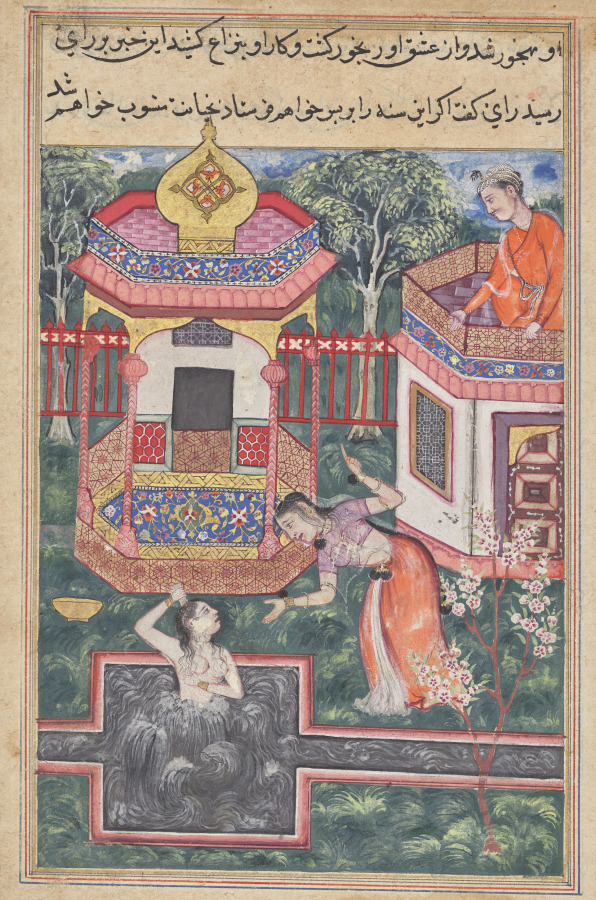
The son of the king of Babylon sees the Brahman transformed into a woman bathing and falls in love with her, from a Tuti-nama (Tales of a Parrot): Thirty-fifth Night (c. 1560) is in the Cleveland Museum of Art collection.
The work and its context
The museum's open-access catalogue describes the work:
One day the king’s son caught sight of a woman washing her hair and fell in love with her. She was actually a Brahmin, a Hindu priest, who had a magic pearl of transformation that allowed him to live in the women’s quarters with his lover, the princess. The princess gestures in alarm, as she realizes her brother has fallen for her lover. Another popular subject that we see in the Tuti-Nama and in later painting is women bathing in a pool. Women bathing also appear in Krishna sporting with the gopis, from the early Bhagavata Purana, CMA 1971.171. Note how the Mughal handling of water with gentle swirls differs from the concentric circles in Krishna sporting with the gopis.
Object facts
- Title: The son of the king of Babylon sees the Brahman transformed into a woman bathing and falls in love with her, from a Tuti-nama (Tales of a Parrot): Thirty-fifth Night
- Date: c. 1560
- Culture: Mughal India, court of Akbar (reigned 1556–1605)
- Type: Painting
- Technique: gum tempera, ink, and gold on paper
- Dimensions: Overall: 20.3 x 14 cm (8 x 5 1/2 in.); Painting only: 14.5 x 10.2 cm (5 11/16 x 4 in.)
- Collection: Indian Art
- Department: Indian and Southeast Asian Art
- Accession number: 1962.279.234.a
A detail from the museum
The prince becomes so lovesick that he nearly dies.
Collection credit
Gift of Mrs. A. Dean Perry
Further reading listed by the museum
- Chandra, Pramod, and Daniel J. Ehnbom. The Cleveland Tuti-Nama Manuscript and the Origins of Mughal Painting. Cleveland: Cleveland Museum of Art, 1976.
View the collection record
See the museum's photographs and full catalogue entry. Catalogue text is reproduced from the Cleveland Museum of Art's open-access data, with HTML formatting removed. This object and its supplied image are designated CC0.
Sources
More in Lifestyle
Keep reading