The Vicarello Goblet (25 BCE–25 CE): Art, History and Details
The Vicarello Goblet at the Cleveland Museum of Art: 25 BCE–25 CE, silver. Explore the work's context, creator attribution and collection history.
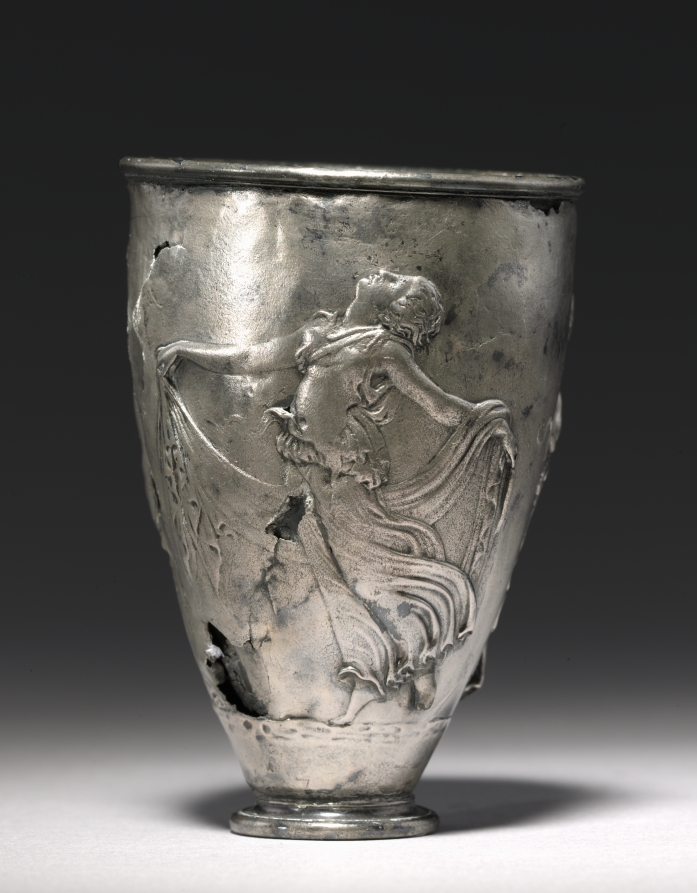
The Vicarello Goblet (25 BCE–25 CE) is in the Cleveland Museum of Art collection.
The work and its context
The museum's open-access catalogue describes the work:
This masterpiece of the Roman silversmith’s art is exquisitely worked in relief. The multifigure scene centers on a rustic shrine of the ithyphallic fertility god Priapus, son of Dionysos. He takes the form of a stylized boundary marker atop a column, where a woman seems to have brought him to life by touching him. To the left sits a table with votive offerings to the god. Flanking the shrine are a satyr and maenad, dancing ecstatically.
Object facts
- Title: The Vicarello Goblet
- Date: 25 BCE–25 CE
- Culture: Italy, Vicarello (ancient Aquae Apollinares), Roman, Augustan period
- Type: Metalwork
- Technique: silver
- Dimensions: Overall: 12.2 x 7.8 cm (4 13/16 x 3 1/16 in.)
- Collection: GR - Roman
- Department: Greek and Roman Art
- Accession number: 1966.371
A detail from the museum
This silver cup was found north of Rome at Vicarello (ancient Aquae Apollinares), probably in 1862.
Collection credit
Purchase from the J. H. Wade Fund
Further reading listed by the museum
- Otto Jahn, Archiologische Zeitung XXV (Berlin, 1867).
- Lièvre, Ed, Bracquemond, Courtry, and Flameng. Works of Art in the Collections of England. Engr. London: [s.n.], 1874.
- Reinach, Salomon. Répertoire de reliefs grecs et romains. Paris: E. Leroux, 1912.
View the collection record
See the museum's photographs and full catalogue entry. Catalogue text is reproduced from the Cleveland Museum of Art's open-access data, with HTML formatting removed. This object and its supplied image are designated CC0.
Sources
More in Lifestyle
Keep reading