The Waterfall of Marmore at Terni (1776–78): Art, History and Details
The Waterfall of Marmore at Terni at the Cleveland Museum of Art: 1776–78, pen and black ink, brush and brown wash, with white gouache and graphite. Explore the work's context, creator attribution and collection history.
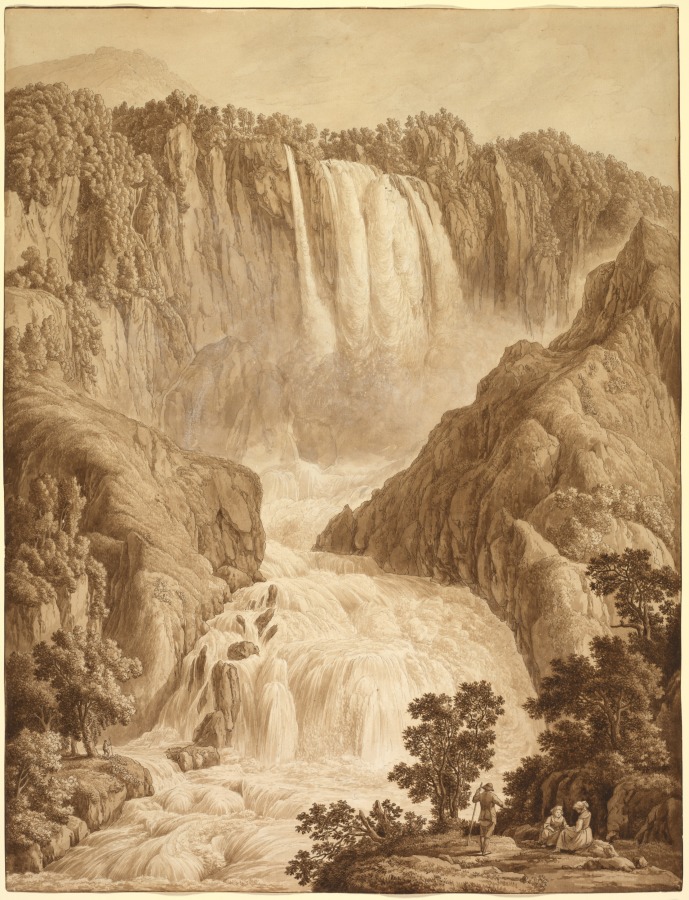
The Waterfall of Marmore at Terni (1776–78) is in the Cleveland Museum of Art collection. The museum's creator attribution is Philipp Hackert (German, 1737–1807).
The work and its context
The museum's open-access catalogue describes the work:
Influenced by the landscapes of Claude Lorrain and seventeenth-century Dutch artists, the German Jakob Philipp Hackert was one of the most successful landscape artists based in late 18th-century Rome. His precise renderings of beautiful and historic sites attracted an international clientele on the European grand tour. This finished drawing depicts one of Italy's most spectacular natural phenomena, the Marmore waterfall at Terni, located north of Rome. Hackert carefully crafted the composition so that the detailed cliffs covered with foliage frame the tiered cascade from its soaring heights to its final emptying in the foreground. Hackert was known for traveling to the countryside on foot with large portfolios so that he could execute complete wash drawings like this one directly in nature. He probably drew this scene during one such sketching tour in 1776, or 1778.
Object facts
- Title: The Waterfall of Marmore at Terni
- Date: 1776–78
- Creator attribution: Philipp Hackert (German, 1737–1807)
- Culture: Germany, 18th century
- Type: Drawing
- Technique: pen and black ink, brush and brown wash, with white gouache and graphite
- Dimensions: Sheet: 52.2 x 39.9 cm (20 9/16 x 15 11/16 in.)
- Collection: DR - German
- Department: Drawings
- Accession number: 1982.40
A detail from the museum
This work recalls the words written by the artist's close friend, Johann Wolfgang von Goethe, who declared that an artist should "give his work of art a content and a form through which it appears both natural and beyond Nature."
Collection credit
Dudley P. Allen Fund
Further reading listed by the museum
- Krönig, Wolfgang. 1971. "Sepia-zeichnungen aus der Umgebung Neapels von Philipp Hackert". Wallraf-Richartz-Jahrbuch / Hrsg. Im Auftr. Der Freunde Des Wallraf-Richartz-Museums Und Des Museums Ludwig E.V., Köln. 175-204.
- Goldfarb, Hilliard, "Defining 'Naive and Sentimental' Landscape. Schiller, Hackert, Koch, and the Romantic Experience," The Bulletin of the Cleveland Museum of Art. Cleveland, Ohio: Cleveland Museum of Art, 1982: pp. 282-296.
- Goldfarb, Hilliard T. “Defining ‘Naive and Sentimental’ Landscape Schiller, Hackert, Koch, and the Romantic Experience.” The Bulletin of the Cleveland Museum of Art 69, no. 9 (November 1982): 282–296.
View the collection record
See the museum's photographs and full catalogue entry. Catalogue text is reproduced from the Cleveland Museum of Art's open-access data, with HTML formatting removed. This object and its supplied image are designated CC0.
Sources
More in Lifestyle
Keep reading