The wounded monkey bites the hand of the prince, his chessmate, in the presence of guests, from a Tuti-nama (Tales of a Parrot): Fifth Night (c. 1560): Art, History and Details
The wounded monkey bites the hand of the prince, his chessmate, in the presence of guests, from a Tuti-nama (Tales of a Parrot): Fifth Night at the Cleveland Museum of Art: c. 1560, gum tempera, ink, and gold on paper. Explore the work's co
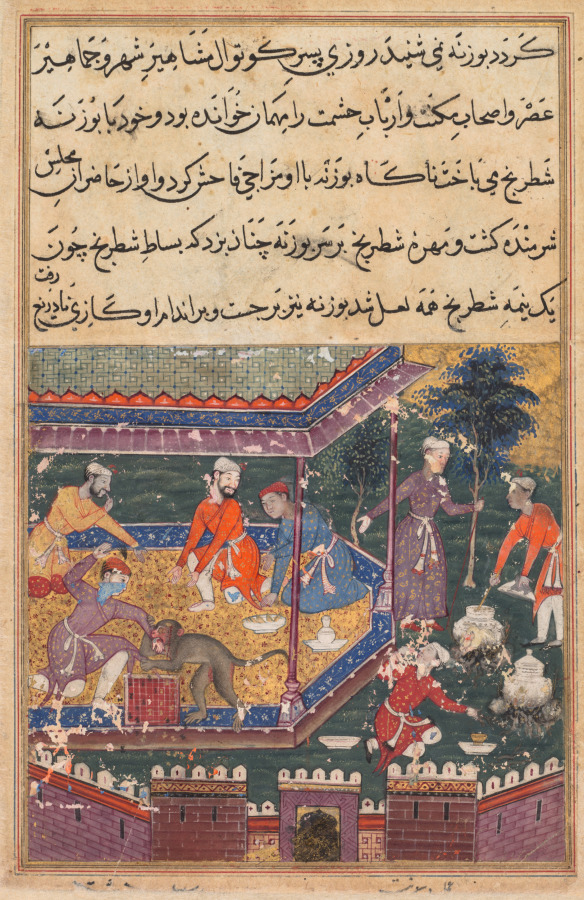
The wounded monkey bites the hand of the prince, his chessmate, in the presence of guests, from a Tuti-nama (Tales of a Parrot): Fifth Night (c. 1560) is in the Cleveland Museum of Art collection. The museum's creator attribution is Dasavanta (Indian, d. 1584).
The work and its context
The museum's open-access catalogue describes the work:
This painting depicts a scene from the cautionary tale the mother parrot tells her young to warn them that interspecies friendships, like theirs with the fox cubs, are a bad idea. She tells them that there once was a monkey who could play chess, and he enjoyed many games with a prince. When the prince invited dignitaries for a party, the monkey made a bad joke, the prince slapped him, and the monkey bit him in return. At the left, food is prepared as the guests look on in astonishment. An inscription at the bottom of the page names the artist, who went on to become one of the most celebrated Indian masters at the Mughal court.
Object facts
- Title: The wounded monkey bites the hand of the prince, his chessmate, in the presence of guests, from a Tuti-nama (Tales of a Parrot): Fifth Night
- Date: c. 1560
- Creator attribution: Dasavanta (Indian, d. 1584)
- Culture: Mughal India, court of Akbar (reigned 1556–1605)
- Type: Painting
- Technique: gum tempera, ink, and gold on paper
- Dimensions: Overall: 20 x 14.2 cm (7 7/8 x 5 9/16 in.); Painting only: 10.2 x 10.6 cm (4 x 4 3/16 in.)
- Collection: Indian Art
- Department: Indian and Southeast Asian Art
- Accession number: 1962.279.32.b
A detail from the museum
Young master artist Dasavanta put a layer of cool blue color under his painting.
Collection credit
Gift of Mrs. A. Dean Perry
Further reading listed by the museum
- Chandra, Pramod, and Daniel J. Ehnbom. The Cleveland Tuti-Nama Manuscript and the Origins of Mughal Painting. [Cleveland]: Cleveland Museum of Art, 1976.
- Chandra, Pramod, and Daniel J. Ehnbom. The Cleveland Tuti-Nama Manuscript and the Origins of Mughal Painting. [Cleveland]: Cleveland Museum of Art, 1976.
- Seyller, John. “Overpainting in the Cleveland T̤ūtīnāma.” Artibus Asiae 52, no. 3/4 (1992): 283-318.
View the collection record
See the museum's photographs and full catalogue entry. Catalogue text is reproduced from the Cleveland Museum of Art's open-access data, with HTML formatting removed. This object and its supplied image are designated CC0.
Sources
More in Lifestyle
Keep reading