The Wrath of Neptune (late 1500s–early 1600s): Art, History and Details
The Wrath of Neptune at the Cleveland Museum of Art: late 1500s–early 1600s, bronze. Explore the work's context, creator attribution and collection history.
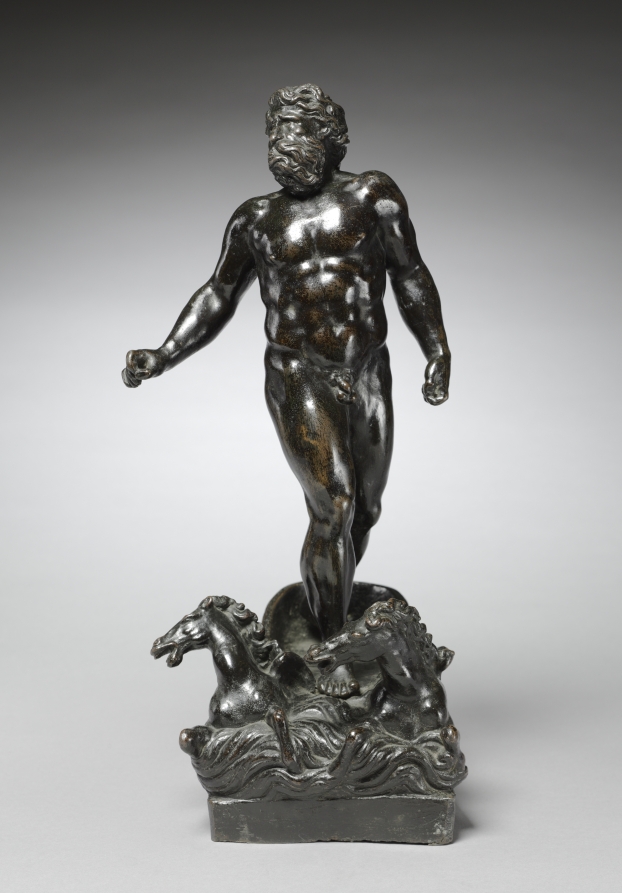
The Wrath of Neptune (late 1500s–early 1600s) is in the Cleveland Museum of Art collection. The museum's creator attribution is Tiziano Minio (Italian, 1511/12–1552).
The work and its context
The museum's open-access catalogue describes the work:
In Roman mythology, Neptune (or Poseidon in Greek mythology) is the god of flowing water and is believed to protect against droughts. This small bronze is likely a sculptural representation of the Wrath of Neptune from the Aeneid. During the Trojan War, Juno incited winds to sink Trojan ships. Infuriated by Juno's incursion into his domain of the sea, Neptune rides out in his chariot, saving the Trojan army and threatening to punish the winds for their insolence. The massive, muscular nude male figure stands upright on his seahorse-drawn chariot, twisting to face the wind. The turbulent waves and the windblown hair and beard of the figure give life to this small bronze. The figure's left hand would have originally held reins, while the right hand, which once held a trident, is outstretched in the act of commanding the waves to be still. This bronze was once attributed by art historian Wilhelm von Bode to Jacopo Sansovino based on its similarity to known works, such as the over-life-size marble figure of Neptune of the Scala di Giganti outside of the Doge's Palace in Venice. However, by 1921 Leo Planiscig had noted the CMA Neptune's similarity to bronzes and reliefs by Sansovino's pupil, Tiziano Minio, in the Loggetta at San Marco Square, Venice. In Minio's Jupiter on the Island of Candia for the Loggetta, the waves are represented with the same incised, undulating grooves as in this work. Neptune possesses the same stocky proportions and heavy musculature which was characteristic of Minio. The high polish and sweeping contours of the figure are characteristic of Sansovino, but the heightened drama of the subject display Minio's stylistic advancement from his teacher.
Object facts
- Title: The Wrath of Neptune
- Date: late 1500s–early 1600s
- Creator attribution: Tiziano Minio (Italian, 1511/12–1552)
- Culture: Italy
- Type: Sculpture
- Technique: bronze
- Dimensions: Overall: 36.7 x 17.2 x 19.4 cm (14 7/16 x 6 3/4 x 7 5/8 in.)
- Collection: Sculpture
- Department: European Painting and Sculpture
- Accession number: 1974.273
Collection credit
Gift of Barrie Morrison
Further reading listed by the museum
- Lee, Sherman E. “The Year in Review for 1974.” The Bulletin of the Cleveland Museum of Art 62, no. 3 (March 1975): 62–102.
- The Cleveland Museum of Art. Handbook of the Cleveland Museum of Art/1978. Cleveland, OH: The Cleveland Museum of Art, 1978.
View the collection record
See the museum's photographs and full catalogue entry. Catalogue text is reproduced from the Cleveland Museum of Art's open-access data, with HTML formatting removed. This object and its supplied image are designated CC0.
Sources
More in Lifestyle
Keep reading