The young prince is crowned and the wicked handmaiden is executed, from a Tuti-nama (Tales of a Parrot): Eighth Night (c. 1560): Art, History and Details
The young prince is crowned and the wicked handmaiden is executed, from a Tuti-nama (Tales of a Parrot): Eighth Night at the Cleveland Museum of Art: c. 1560, gum tempera, ink, and gold on paper. Explore the work's context, creator attribut
The young prince is crowned and the wicked handmaiden is executed, from a Tuti-nama (Tales of a Parrot): Eighth Night (c. 1560) is in the Cleveland Museum of Art collection. The museum's creator attribution is Suraju (Indian).
The work and its context
The museum's open-access catalogue describes the work:
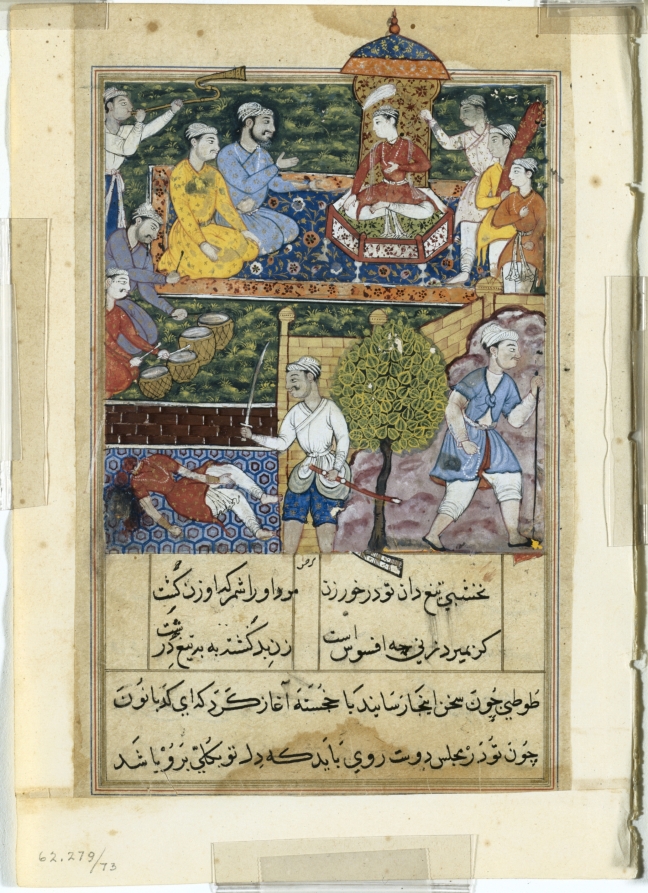
In the concluding illustration to the parrot's story on the eighth night, the prince is enthroned at the top of the composition to the accompaniment of musical fanfare. His father the king, in blue at the lower right, heads off to retirement in the forest, as was customary, with his walking stick and prayer beads. The ends of garments visible below the picture plane reveal that another earlier composition was painted over—a common practice throughout the Tales of a Parrot in which new recruits to the atelier were experimenting with a new style.
Object facts
- Title: The young prince is crowned and the wicked handmaiden is executed, from a Tuti-nama (Tales of a Parrot): Eighth Night
- Date: c. 1560
- Creator attribution: Suraju (Indian)
- Culture: Mughal India, court of Akbar (reigned 1556–1605)
- Type: Painting
- Technique: gum tempera, ink, and gold on paper
- Dimensions: Overall: 20.1 x 14.3 cm (7 15/16 x 5 5/8 in.); Painting only: 13 x 10.1 cm (5 1/8 x 4 in.)
- Collection: Indian Art
- Department: Indian and Southeast Asian Art
- Accession number: 1962.279.73.a
A detail from the museum
The king, holding a staff and rosary, is leaving to begin life of retirement as an ascetic.
Collection credit
Gift of Mrs. A. Dean Perry
Further reading listed by the museum
- Chandra, Pramod, and Daniel J. Ehnbom. The Cleveland Tuti-Nama Manuscript and the Origins of Mughal Painting. Cleveland, OH: The Cleveland Museum of Art, 1976.
- Seyller, John. “Overpainting in the Cleveland T̤ūtīnāma.” Artibus Asiae 52, no. 3/4 (1992): 283–318.
- Mace, Sonya Rhie, Mohsen Ashtiany, Catherine Glynn, Pedro Moura Carvalho, Marcus Fraser, and Ruby Lal. Mughal Paintings: Art and Stories: the Cleveland Museum of Art. London: D Giles Limited, 2016.
View the collection record
See the museum's photographs and full catalogue entry. Catalogue text is reproduced from the Cleveland Museum of Art's open-access data, with HTML formatting removed. This object and its supplied image are designated CC0.
Sources
More in Lifestyle
Keep reading