Tide-Changing Jewel with Dragon (early 1900s): Art, History and Details
Tide-Changing Jewel with Dragon at the Cleveland Museum of Art: early 1900s, silver, shakudō (copper and gold alloy), and crystal. Explore the work's context, creator attribution and collection history.
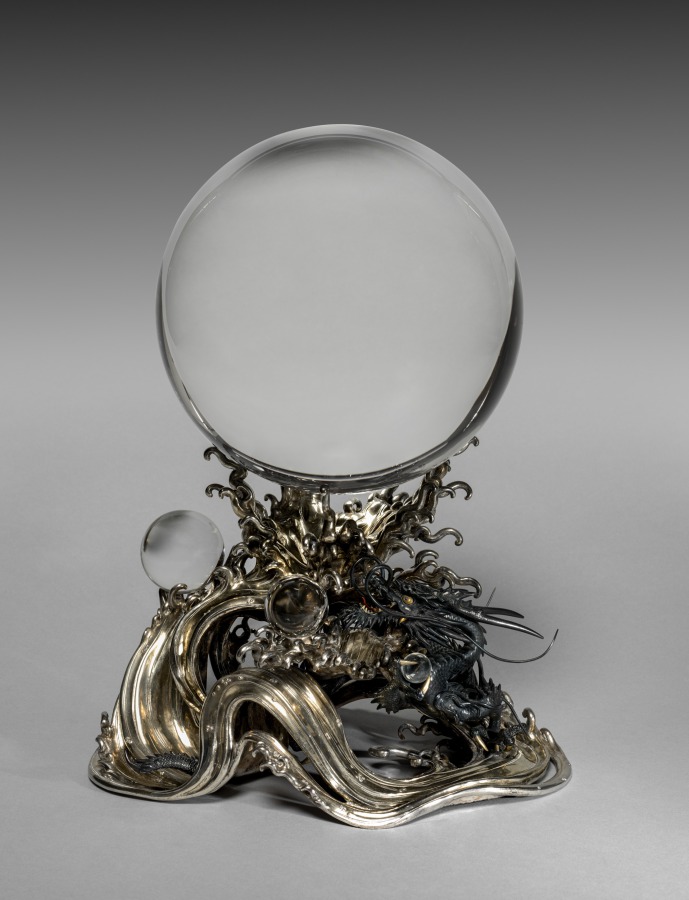
Tide-Changing Jewel with Dragon (early 1900s) is in the Cleveland Museum of Art collection.
The work and its context
The museum's open-access catalogue describes the work:
An early Japanese legend describes a god of the sea who possesses two jewels responsible for controlling the ebb and flow of the tides. In other legends, the jewels belong to the Dragon King who rules from a palace beyond or beneath the sea. Tales received from China feature dragons that can generate rain by using pearls. This okimono (a small sculptural object without a function) mines imagery associated with these tales while aiming to appeal to the interest in gems and minerals embraced by some Americans and Europeans of the late 1800s and early 1900s.
Object facts
- Title: Tide-Changing Jewel with Dragon
- Date: early 1900s
- Culture: Japan, Meiji period (1868–1912)
- Type: Metalwork
- Technique: silver, shakudō (copper and gold alloy), and crystal
- Dimensions: height with stand: 35.6 cm (14 in.); Diameter: 20 cm (7 7/8 in.)
- Collection: Japanese Art
- Department: Japanese Art
- Accession number: 1947.682
Collection credit
Bequest of Cornelia Blakemore Warner
Further reading listed by the museum
- Foxwell, Chelsea, and Bradley M. Bailey. Meiji Modern: Fifty Years of New Japan. Lexington, MA: Japanese Art Society of America, 2023.
View the collection record
See the museum's photographs and full catalogue entry. Catalogue text is reproduced from the Cleveland Museum of Art's open-access data, with HTML formatting removed. This object and its supplied image are designated CC0.
Sources
More in Lifestyle
Keep reading