Tile Spandrel with Floral Sprays (c. 1570–75): Art, History and Details
Tile Spandrel with Floral Sprays at the Cleveland Museum of Art: c. 1570–75, Fritware with red slip and underglaze design. Explore the work's context, creator attribution and collection history.
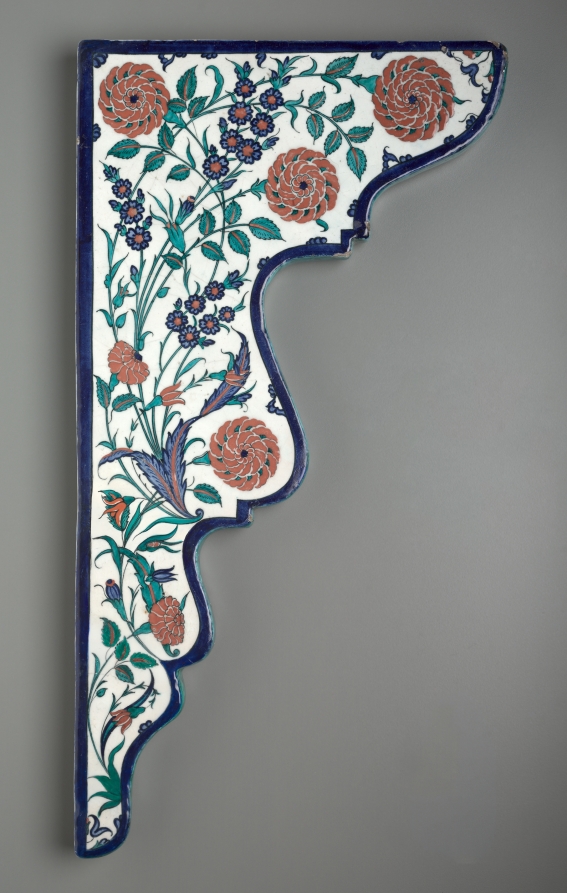
Tile Spandrel with Floral Sprays (c. 1570–75) is in the Cleveland Museum of Art collection.
The work and its context
The museum's open-access catalogue describes the work:
This spandrel, along with its missing right half, would have formed a decorative archway over a niche, window, or door. It reveals the artistic and technical height achieved in Iznik, a town in northwest Turkey. Craftspeople from Iznik were renowned for their production of brilliantly colored tiles for the Ottoman sultans, rulers of one of the most powerful empires in history. The intense red on this spandrel was a technical triumph achieved with a thick iron-rich clay slip. Here, it forms red roses intertwined with leaves and other blossoms.
Object facts
- Title: Tile Spandrel with Floral Sprays
- Date: c. 1570–75
- Culture: Turkey, Iznik, Ottoman period (1299–1922)
- Type: Ceramic
- Technique: Fritware with red slip and underglaze design
- Dimensions: Overall: 76 x 29.9 x 2.5 cm (29 15/16 x 11 3/4 x 1 in.)
- Collection: Islamic Art
- Department: Islamic Art
- Accession number: 2004.70
A detail from the museum
The tile's radiant floral sprays evoke eternal spring and visions of paradise.
Collection credit
Dudley P. Allen Fund
Further reading listed by the museum
- "Major Acquisitions 2000-2005." Cleveland Art: Cleveland Museum of Art Members Magazine 45, no. 6 (July/August 2005): 6–17.
View the collection record
See the museum's photographs and full catalogue entry. Catalogue text is reproduced from the Cleveland Museum of Art's open-access data, with HTML formatting removed. This object and its supplied image are designated CC0.
Sources
More in Lifestyle
Keep reading