Tlaloc (c. 1200–1519): Art, History and Details
Tlaloc at the Cleveland Museum of Art: c. 1200–1519, stone. Explore the work's context, creator attribution and collection history.
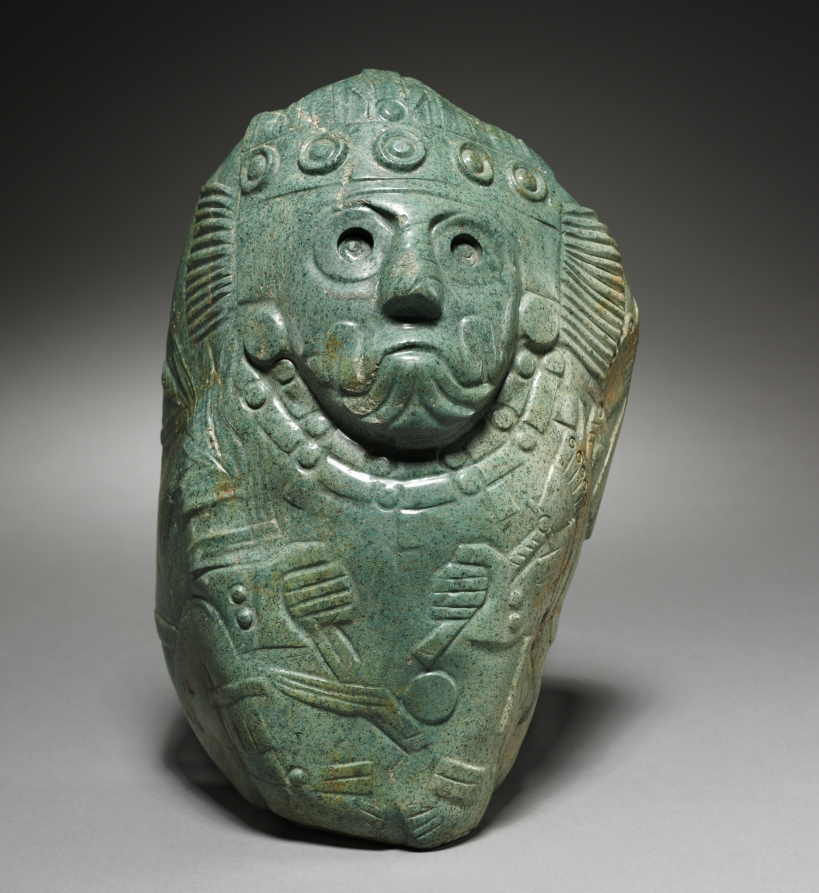
Tlaloc (c. 1200–1519) is in the Cleveland Museum of Art collection.
The work and its context
The museum's open-access catalogue describes the work:
A natural cobble of greenstone has been smoothed and carved in low relief to portray the Aztec rain god Tlaloc, recognizable by his ringed eyes, twisted nose element, and fanged mouth. As the provider of water, Tlaloc is a patron of agriculture and holds a stalk of maize in one hand. To the Aztecs, Tlaloc was an ancient and civilized god; his worship could be traced back to the ancient ruined site Teotihuacan.
Object facts
- Title: Tlaloc
- Date: c. 1200–1519
- Culture: Central Mexico, Aztec, 13th-16th century
- Type: Sculpture
- Technique: stone
- Dimensions: Overall: 29 x 19.5 x 13.5 cm (11 7/16 x 7 11/16 x 5 5/16 in.)
- Collection: AA - Mesoamerica
- Department: Art of the Americas
- Accession number: 1966.361
Collection credit
Purchase from the J. H. Wade Fund
Further reading listed by the museum
- “Year in Review.” The Bulletin of the Cleveland Museum of Art 54, no. 10 (December 1967): 302–346.
- The Cleveland Museum of Art. Handbook of the Cleveland Museum of Art/1969. Cleveland, OH: The Cleveland Museum of Art, 1969.
- The Cleveland Museum of Art. Handbook of the Cleveland Museum of Art/1978. Cleveland, OH: The Cleveland Museum of Art, 1978.
View the collection record
See the museum's photographs and full catalogue entry. Catalogue text is reproduced from the Cleveland Museum of Art's open-access data, with HTML formatting removed. This object and its supplied image are designated CC0.
Sources
More in Lifestyle
Keep reading