Tomb Guardians (early 700s): Art, History and Details
Tomb Guardians at the Cleveland Museum of Art: early 700s, glazed earthenware, sancai (three-color) ware. Explore the work's context, creator attribution and collection history.
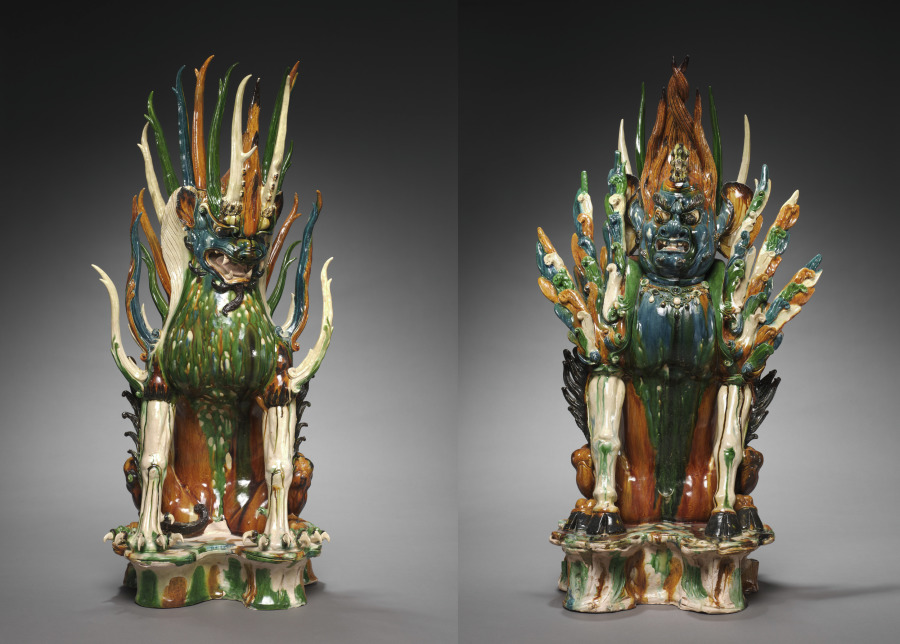
Tomb Guardians (early 700s) is in the Cleveland Museum of Art collection.
The work and its context
The museum's open-access catalogue describes the work:
With fierce expressions, elongated spikes, and exaggerated physical features, these two fantastic creatures were intended to guard the entrance to a tomb, warding off evil as well as keeping the soul of the deceased from wandering. Known as qitou, or earth spirits, both sculptures differ in appearance: one has an animal face, claws, and a pair of antlers; the other sports a human face with huge ears, hooves, and a short horn.
Object facts
- Title: Tomb Guardians
- Date: early 700s
- Culture: China, probably Shaanxi province, Xi'an, Tang dynasty (618-907)
- Type: Ceramic
- Technique: glazed earthenware, sancai (three-color) ware
- Dimensions: Part 1: 92.3 x 43.8 x 41.9 cm (36 5/16 x 17 1/4 x 16 1/2 in.); Part 2: 88.9 x 41 x 50.8 cm (35 x 16 1/8 x 20 in.)
- Collection: China - Tang Dynasty
- Department: Chinese Art
- Accession number: 2000.118
A detail from the museum
Sancai (three-color) glazes in green, amber, and transparent white, plus expensive cobalt blue glaze, show the high social status of the tomb’s occupant.
Collection credit
Gift of various donors to the department of Asian Art (by exchange)
Further reading listed by the museum
- Cleveland Museum of Art, “Tomb Guardian Pair from Tang Dynasty Acquired by CMA,” December 12, 2000, Cleveland Museum of Art Archives.
- May, Sally Ruth, Jane Takac, and Barbara J. Bradley. Knockouts: A Pocket Guide. Cleveland: Cleveland Museum of Art, 2001.
- Franklin, David and C. Griffith Mann. Treasures from the Cleveland Museum of Art. Cleveland, OH: Cleveland Museum of Art, 2012.
View the collection record
See the museum's photographs and full catalogue entry. Catalogue text is reproduced from the Cleveland Museum of Art's open-access data, with HTML formatting removed. This object and its supplied image are designated CC0.
Sources
More in Lifestyle
Keep reading