Torso of a Kouros (c. 550 BCE): Art, History and Details
Torso of a Kouros at the Cleveland Museum of Art: c. 550 BCE, marble. Explore the work's context, creator attribution and collection history.
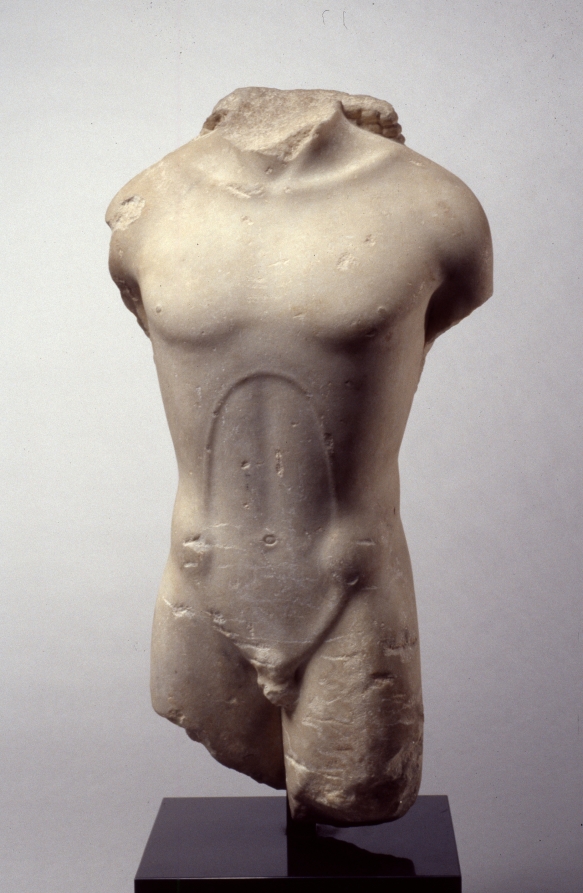
Torso of a Kouros (c. 550 BCE) is in the Cleveland Museum of Art collection.
The work and its context
The museum's open-access catalogue describes the work:
Known as a kouros, the ancient Greek word for a youth, this fragmentary statue belongs to a relatively rare type of large-scale stone sculpture made for little more than a century—shortly before 600 BCE to soon after 500 BCE. A nude youth standing with arms to the sides and one foot slightly advanced, the type probably originated under Egyptian influence, but then developed along entirely Greek lines. Found in sanctuaries as well as cemeteries across the ancient Greek world, kouroi may represent gods—especially Apollo—as well as mortals. Although incomplete, this kouros retains much of its beautifully finished and patterned surface.
Object facts
- Title: Torso of a Kouros
- Date: c. 550 BCE
- Culture: Greece, Archaic period
- Type: Sculpture
- Technique: marble
- Dimensions: Overall: 62.5 cm (24 5/8 in.)
- Collection: GR - Greek
- Department: Greek and Roman Art
- Accession number: 1953.125
A detail from the museum
In antiquity, brightly colored paint would probably have rendered this kouros more lifelike.
Collection credit
Gift of the Hanna Fund
Further reading listed by the museum
- Archaeology. “Archaeological News.” Archaeology, Vol. 7, No. 4 (December 1954): 252.
- Lee, Sherman E. “The Cleveland Kouros.” The Bulletin of the Cleveland Museum of Art 41, no. 3 (1954): 43–51.
- The Cleveland Museum of Art. The Cleveland Museum of Art Handbook. Cleveland, OH: The Cleveland Museum of Art, 1958.
View the collection record
See the museum's photographs and full catalogue entry. Catalogue text is reproduced from the Cleveland Museum of Art's open-access data, with HTML formatting removed. This object and its supplied image are designated CC0.
Sources
More in Lifestyle
Keep reading