Tulwar Sword (case) (1700s): Art, History and Details
Tulwar Sword (case) at the Cleveland Museum of Art: 1700s, wood scabbard with velvet and metallic thread. Explore the work's context, creator attribution and collection history.
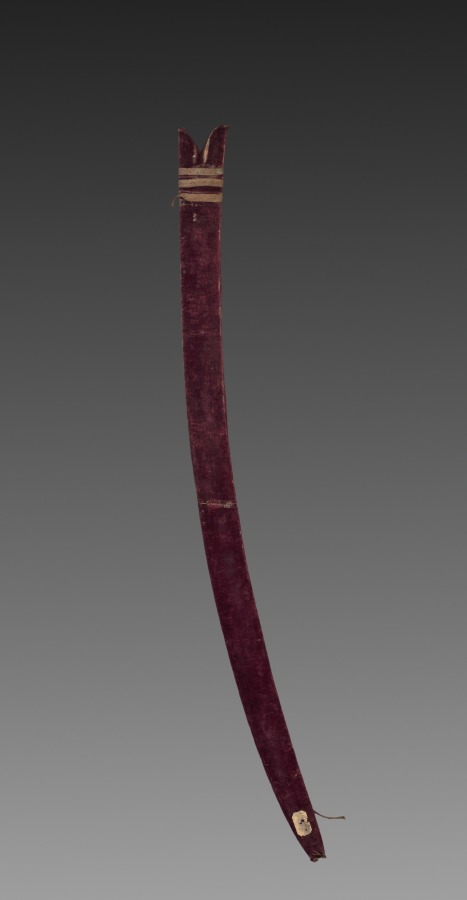
Tulwar Sword (case) (1700s) is in the Cleveland Museum of Art collection.
The work and its context
The museum's open-access catalogue describes the work:
This long curved sword and scabbard are of the kind used and worn by Mughal nobility, as seen often in paintings. The openwork hilt is characteristic of swords from the southern Indian region known as the Deccan. By the end of the 1500s, the Mughals began making regular incursions into the Deccan as they attempted to expand their empire, increasing the exchange of art forms.
Object facts
- Title: Tulwar Sword (case)
- Date: 1700s
- Culture: India, probably Deccan
- Type: Arms and Armor
- Technique: wood scabbard with velvet and metallic thread
- Dimensions: Overall: 96.6 cm (38 1/16 in.)
- Collection: Indian Art
- Department: Indian and Southeast Asian Art
- Accession number: 1930.704.b
Collection credit
Gift of S. D. Wright
Further reading listed by the museum
- “Part II. Fifteenth Annual Report of the Cleveland Museum of Art 1930.” The Bulletin of the Cleveland Museum of Art, vol. 18, no. 2, 1931, pp. 1–128.
View the collection record
See the museum's photographs and full catalogue entry. Catalogue text is reproduced from the Cleveland Museum of Art's open-access data, with HTML formatting removed. This object and its supplied image are designated CC0.
Sources
More in Lifestyle
Keep reading