Tunic (400–200 BCE): Art, History and Details
Tunic at the Cleveland Museum of Art: 400–200 BCE, looped camelid fiber. Explore the work's context, creator attribution and collection history.
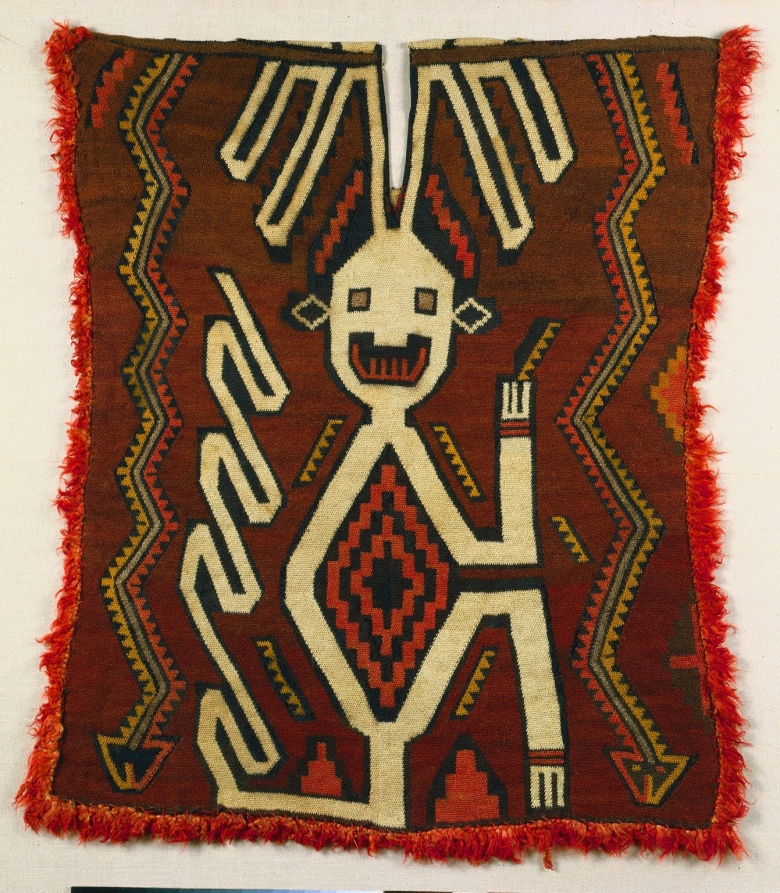
Tunic (400–200 BCE) is in the Cleveland Museum of Art collection.
The work and its context
The museum's open-access catalogue describes the work:
The striking, large-scale figure shown on this tunic has an elaborate, monkey-like tail as well as head appendages that mark the creature as supernatural. This tunic, a relatively rare type, was made not on a loom but rather by working the yarns into loops with a needle. It is made entirely with camelid fiber, which can readily be dyed in a range of vivid colors. The fiber comes from one of the four camels (camelids) native to the Andes Mountains—the alpaca and llama, both domesticated, and the wild guanaco and vicuña. On the coast, it represents a prestige import.
Object facts
- Title: Tunic
- Date: 400–200 BCE
- Culture: Peru, South Coast, Ica Valley, Ocucaje site?, Paracas people
- Type: Textile
- Technique: looped camelid fiber
- Dimensions: Average: 94 x 82.6 cm (37 x 32 1/2 in.)
- Collection: T - Pre-Columbian
- Department: Textiles
- Accession number: 1940.514
A detail from the museum
The red dyes in this tunic likely come from madder root.
Collection credit
The Norweb Collection
Further reading listed by the museum
- Milliken, William M. "Exhibition of the "Art of the Americas"." The Bulletin of the Cleveland Museum of Art 32, no. 9 (1945)
- Society of the Four Arts (Palm Beach, Fla.), and Gordon F. Ekholm. Pre-Columbian Art, the Native Art of America Before the Conquest: Jan. 10-Feb. 1, 1953. Palm Beach: Society of the Four Arts, 1952.
- Museum of Modern Art (New York, N.Y.), and Wendell Clark Bennett. 32 Masterworks of Andean Art from the Exhibition Ancient Arts of the Andes. 1955.
View the collection record
See the museum's photographs and full catalogue entry. Catalogue text is reproduced from the Cleveland Museum of Art's open-access data, with HTML formatting removed. This object and its supplied image are designated CC0.
Sources
More in Lifestyle
Keep reading