Tunic Fragments with Bird-Headed Creature (600–1000): Art, History and Details
Tunic Fragments with Bird-Headed Creature at the Cleveland Museum of Art: 600–1000, Camelid fiber, cotton: tapestry weave. Explore the work's context, creator attribution and collection history.
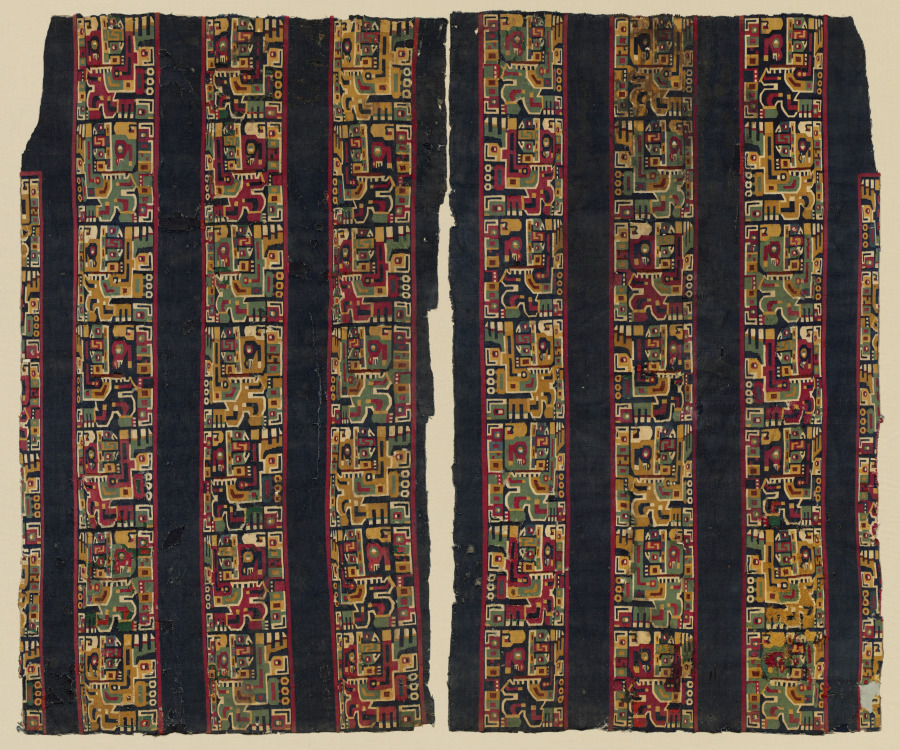
Tunic Fragments with Bird-Headed Creature (600–1000) is in the Cleveland Museum of Art collection.
The work and its context
The museum's open-access catalogue describes the work:
The bird-headed creature in profile that repeats in each of this tunic's design fields gazes upward, holds a staff of authority in front of its body, and wears an ornate headdress behind which a three-feathered wing can be seen. The extremely high technical quality of such tunics suggests that the Wari reserved bird imagery for their most exalted rulers. Here, the original incorporated more than twice as much yarn as the routine--some 19 miles, all handmade and much dyed an inky, dark blue, the most prestigious of Wari colors.
Object facts
- Title: Tunic Fragments with Bird-Headed Creature
- Date: 600–1000
- Culture: Central Andes, Wari culture, Middle Horizon era, 7th–11th century
- Type: Textile
- Technique: Camelid fiber, cotton: tapestry weave
- Dimensions: Overall: 88.6 x 101.9 cm (34 7/8 x 40 1/8 in.)
- Collection: T - Pre-Columbian
- Department: Textiles
- Accession number: 2005.53
Collection credit
Purchase from the J. H. Wade Fund
Further reading listed by the museum
- Bergh, Susan E., "From the Realm of the Condor", Cleveland Museum of Art. Cleveland Art: The Cleveland Museum of Art Members Magazine. Vol. 47 no. 08, October 2007
- Bergh, Susan E., Luis Guillermo Lumbreras, and Luis Jaime Castillo. Wari: Lords of the Ancient Andes. [New York]: Thames & Hudson; [Cleveland] : The Cleveland Museum of Art, 2012.
- Bergh, Susan E. "Lords of the Ancient Andes." Cleveland Art: Cleveland Museum of Art Members Magazine 52, no. 6 (November/December 2012): 4-6.
View the collection record
See the museum's photographs and full catalogue entry. Catalogue text is reproduced from the Cleveland Museum of Art's open-access data, with HTML formatting removed. This object and its supplied image are designated CC0.
Sources
More in Lifestyle
Keep reading