Tunic with Sacrificer (600–1000): Art, History and Details
Tunic with Sacrificer at the Cleveland Museum of Art: 600–1000, camelid fiber, cotton: tapestry weave. Explore the work's context, creator attribution and collection history.
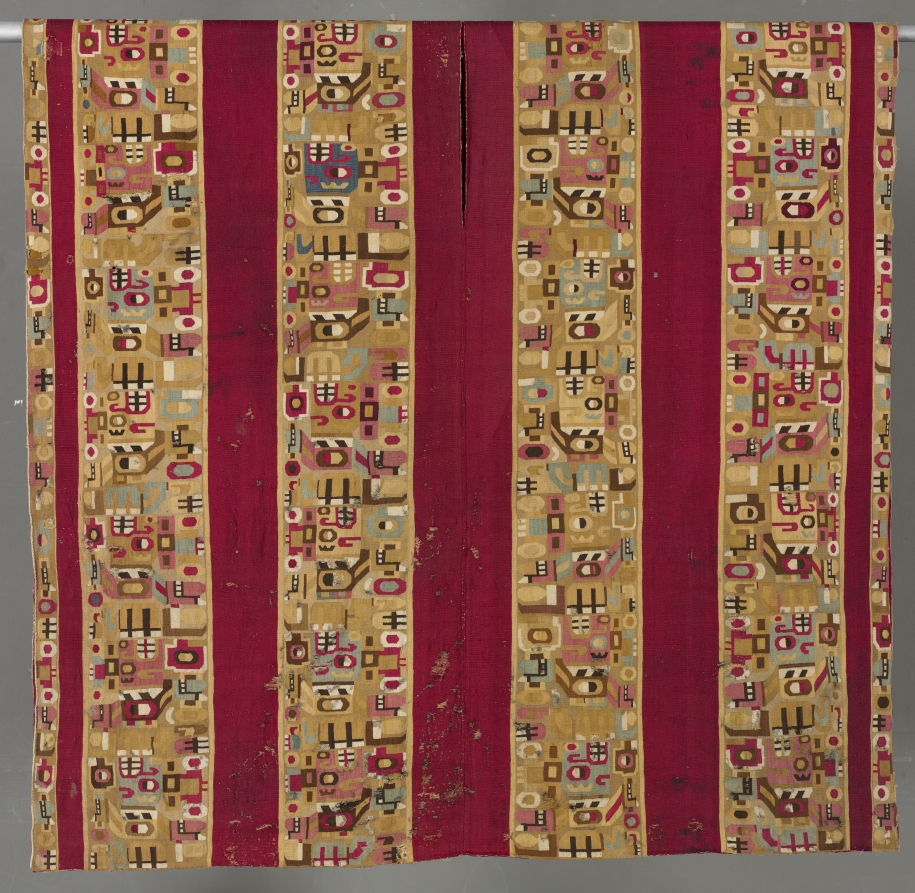
Tunic with Sacrificer (600–1000) is in the Cleveland Museum of Art collection.
The work and its context
The museum's open-access catalogue describes the work:
A highly abstract supernatural sacrificer repeats in different colors and orientations across the body of this tunic, which was shortened on one side in antiquity. Look for the toothy black-and-white mouth in the sacrificer's upward-gazing head; other facial features include a button nose and a vertically divided eye. The figure holds the L-shaped handle of an axe behind its back and, at the front of its body, a short staff with a severed, upside-down human head on the top.
Object facts
- Title: Tunic with Sacrificer
- Date: 600–1000
- Culture: South America, Peru, Central Andes, Wari people, Middle Horizon era, 7th–11th century
- Type: Textile
- Technique: camelid fiber, cotton: tapestry weave
- Dimensions: Overall: 202.6 x 112 cm (79 3/4 x 44 1/8 in.)
- Collection: T - Pre-Columbian
- Department: Textiles
- Accession number: 2007.179
Collection credit
John L. Severance Fund
Further reading listed by the museum
- Bergh, Susan E., Luis Guillermo Lumbreras, and Luis Jaime Castillo. Wari: Lords of the Ancient Andes. [New York]: Thames & Hudson; [Cleveland] : The Cleveland Museum of Art, 2012.
View the collection record
See the museum's photographs and full catalogue entry. Catalogue text is reproduced from the Cleveland Museum of Art's open-access data, with HTML formatting removed. This object and its supplied image are designated CC0.
Sources
More in Lifestyle
Keep reading