Turned Armilla (c. 1500 BCE): Art, History and Details
Turned Armilla at the Cleveland Museum of Art: c. 1500 BCE, bronze, wrought. Explore the work's context, creator attribution and collection history.
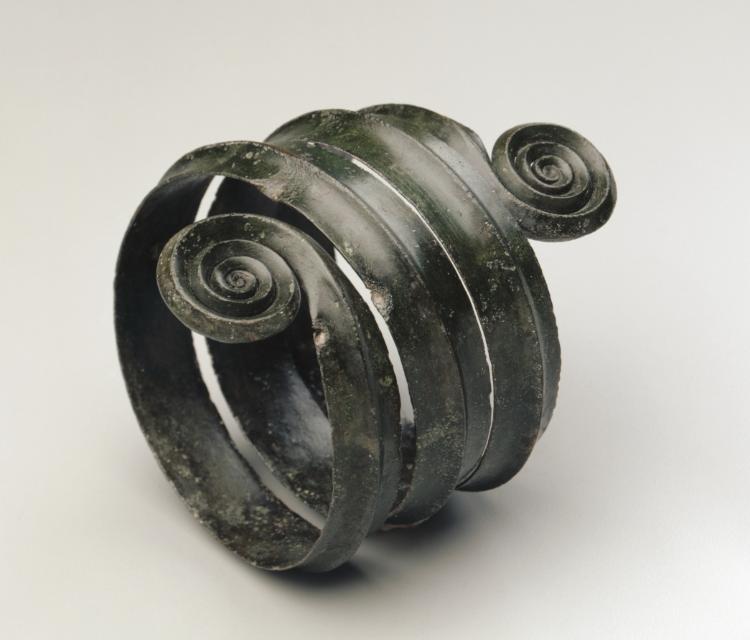
Turned Armilla (c. 1500 BCE) is in the Cleveland Museum of Art collection.
The work and its context
The museum's open-access catalogue describes the work:
Europe. As the spiral mimics forms found in nature - specifically in nautilus shells - it is the basis for logarithmic measures of progression in measurement and growth, which in turn help establish the Fibonacci sequence. Through this sequence we can analyze the phenomenon of spiral designs, specifically in nautilus shells, where the radius of each new chamber grows at a rate determined by a specific proportion to the previous one.
Object facts
- Title: Turned Armilla
- Date: c. 1500 BCE
- Culture: Hungary, Bronze Age
- Type: Metalwork
- Technique: bronze, wrought
- Dimensions: Overall: 12.5 x 10.4 cm (4 15/16 x 4 1/8 in.)
- Collection: GR - European Bronze Age
- Department: Greek and Roman Art
- Accession number: 1988.5
A detail from the museum
This armilla or arm ornament has a ridge along the spine, ending in a spiral at both ends.
Collection credit
Purchase from the J. H. Wade Fund
Further reading listed by the museum
- “The Year in Review for 1988.” The Bulletin of the Cleveland Museum of Art 76, no. 2 (February 1989): 30–75.
- The Cleveland Museum of Art. Handbook of the Cleveland Museum of Art. Cleveland, OH: The Cleveland Museum of Art, 1991.
- Kozloff, Arielle P. "Ancient East-European Bronzes." The Bulletin of the Cleveland Museum of Art 80, no. 4 (1993): 122-26.
View the collection record
See the museum's photographs and full catalogue entry. Catalogue text is reproduced from the Cleveland Museum of Art's open-access data, with HTML formatting removed. This object and its supplied image are designated CC0.
Sources
More in Lifestyle
Keep reading