Twelve-sided Ewer with Sphinxes and Human-Headed Inscriptions (1300–1350): Art, History and Details
Twelve-sided Ewer with Sphinxes and Human-Headed Inscriptions at the Cleveland Museum of Art: 1300–1350, hammered sheet of brass inlaid with silver. Explore the work's context, creator attribution and collection history.
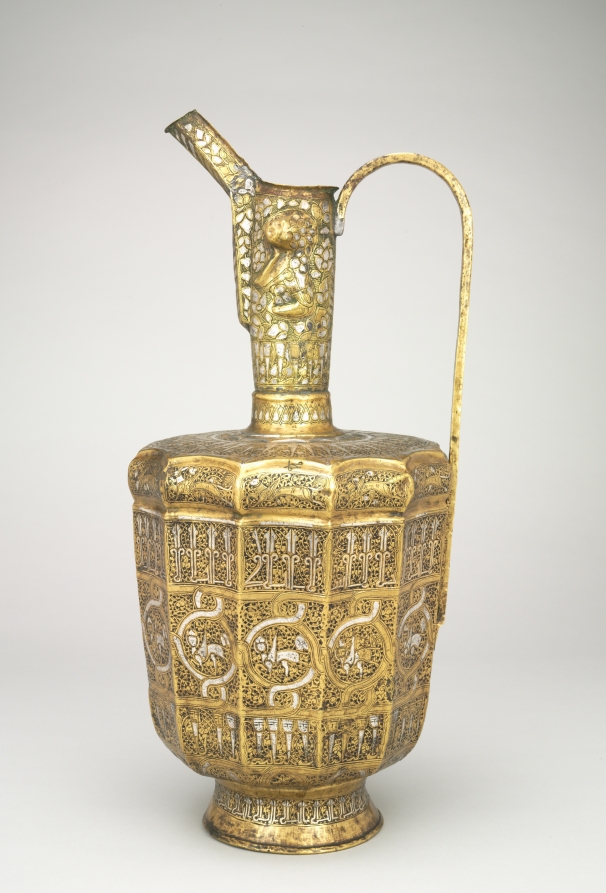
Twelve-sided Ewer with Sphinxes and Human-Headed Inscriptions (1300–1350) is in the Cleveland Museum of Art collection.
The work and its context
The museum's open-access catalogue describes the work:
The spout and neck of the ewer display a crouching and seated lion in raised relief. Winged hare-like animals march around the top of the body, set off by foliate scrolls, while sphinxes process around the center. The bottom of the ewer’s body is encircled by an inscription with human heads, which only appear on metalwork in Islamic art. Ewers like this, and similar elaborate vessels, would have been used in court banquets and elite homes across the Islamic world.
Object facts
- Title: Twelve-sided Ewer with Sphinxes and Human-Headed Inscriptions
- Date: 1300–1350
- Culture: Iran, Khurasan, Ilkhanid period (1256–1353)
- Type: Metalwork
- Technique: hammered sheet of brass inlaid with silver
- Dimensions: Overall: 44.8 cm (17 5/8 in.)
- Collection: Islamic Art
- Department: Islamic Art
- Accession number: 1945.27
A detail from the museum
Calligraphy with human heads, known as animated script, developed in northeast Iran during the 1100s.
Collection credit
Purchase from the J. H. Wade Fund
Further reading listed by the museum
- Lethaby, W. R. "Notes." The Burlington Magazine for Connoisseurs 23, no. 124 (July 1913): 246-51.
- "Closing Days of the Inaugural Exhibition." The Bulletin of the Cleveland Museum of Art 3, no. 3 (1916): 1-4.
View the collection record
See the museum's photographs and full catalogue entry. Catalogue text is reproduced from the Cleveland Museum of Art's open-access data, with HTML formatting removed. This object and its supplied image are designated CC0.
Sources
More in Lifestyle
Keep reading