Twin Figure (Ère Ìbejì) (late 1800s–early 1900s): Art, History and Details
Twin Figure (Ère Ìbejì) at the Cleveland Museum of Art: late 1800s–early 1900s, Wood, copper alloy, iron alloy, lead, glass beads, cowrie shells, twine, and pigment. Explore the work's context, creator attribution and collection history.
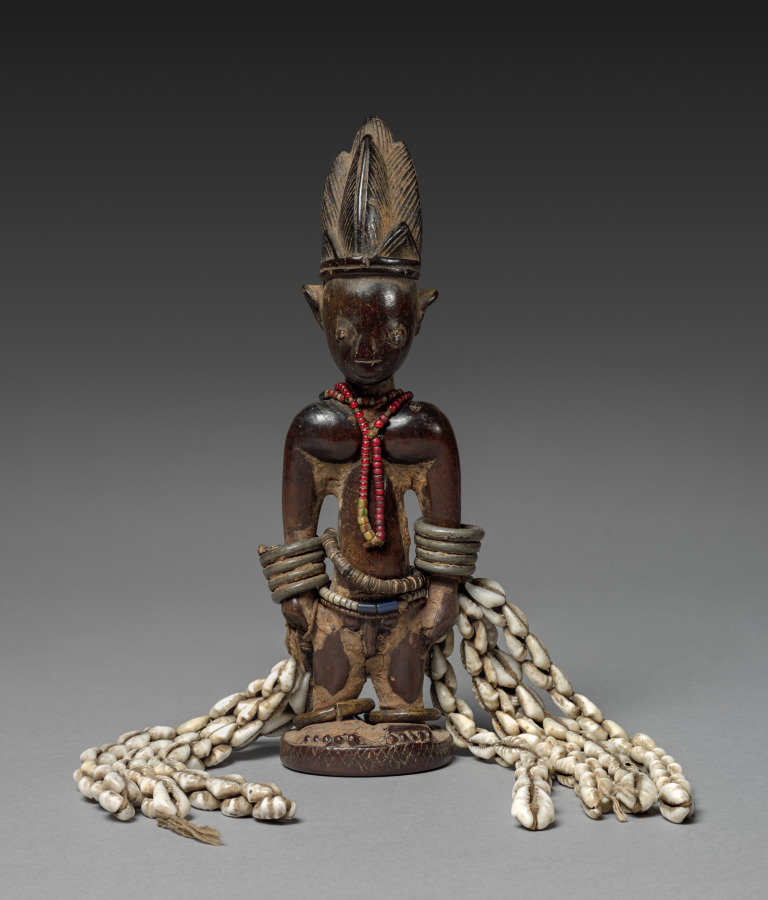
Twin Figure (Ère Ìbejì) (late 1800s–early 1900s) is in the Cleveland Museum of Art collection.
The work and its context
The museum's open-access catalogue describes the work:
Such a figure is carved when a twin dies in infancy and serves as a memorial to the surviving sibling. These twin figures are always carved to look like adult individuals with idealized physical features. Various body adornments suggest the care parents devote to their children, while the erosion of facial features indicates the symbolic washing and feeding of the figure as a means to connect the soul of the deceased to that of the living twin.
Object facts
- Title: Twin Figure (Ère Ìbejì)
- Date: late 1800s–early 1900s
- Culture: Africa, West Africa, Nigeria, Yorùbá-style maker
- Type: Sculpture
- Technique: Wood, copper alloy, iron alloy, lead, glass beads, cowrie shells, twine, and pigment
- Dimensions: Overall: 25.6 x 18.8 x 5.8 cm (10 1/16 x 7 3/8 x 2 5/16 in.)
- Collection: African Art
- Department: African Art
- Accession number: 2016.9
A detail from the museum
This figure commemorates a twin that has died in infancy.
Collection credit
Gift of Kim Sherwin
Further reading listed by the museum
- Smith, Fred T., Judith Perani, Joseph L. Underwood, and Martha J. Ehrlich. The Visual Arts of Africa : Gender, Power, and Life Cycle Rituals. Second edition. New York: Oxford University Press, 2022.
View the collection record
See the museum's photographs and full catalogue entry. Catalogue text is reproduced from the Cleveland Museum of Art's open-access data, with HTML formatting removed. This object and its supplied image are designated CC0.
Sources
More in Lifestyle
Keep reading
Related stories