Two-color Velvet with Gold in a Double Curved Lattice Pattern (1450–1500): Art, History and Details
Two-color Velvet with Gold in a Double Curved Lattice Pattern at the Cleveland Museum of Art: 1450–1500, silk, gold thread; polychrome velvet: cut pile, brocaded, and voided. Explore the work's context, creator attribution and collection hi
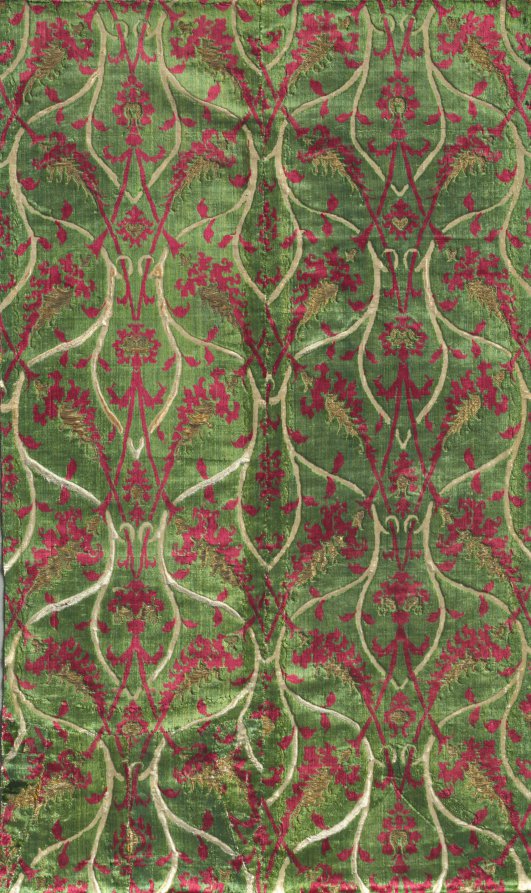
Two-color Velvet with Gold in a Double Curved Lattice Pattern (1450–1500) is in the Cleveland Museum of Art collection.
The work and its context
The museum's open-access catalogue describes the work:
Although plain velvets were woven in Italy by the end of the 13th century, polychrome-patterned velvets were not produced until the late 14th century. This velvet with two colors of pile incorporates a limited amount of costly gold thread while a fourth color, ivory, is formed by the satin weave of the foundation, called voided velvet. Palmette leaves composed of gold thread and crimson pile dominate the pattern on the green pile ground. The palmettes are arranged in an overlapping curved layout, popular in Italy and in Ottoman Turkey during the second half of the 15th century.
Object facts
- Title: Two-color Velvet with Gold in a Double Curved Lattice Pattern
- Date: 1450–1500
- Culture: Italy, possibly Florence, 15th century
- Type: Velvet
- Technique: silk, gold thread; polychrome velvet: cut pile, brocaded, and voided
- Dimensions: Overall: 108.6 x 55.9 cm (42 3/4 x 22 in.); Mounted: 115.6 x 59.7 cm (45 1/2 x 23 1/2 in.)
- Collection: Textiles
- Department: Textiles
- Accession number: 1929.82
Collection credit
Purchase from the J. H. Wade Fund
Further reading listed by the museum
- Falke, Otto von. 1928. “Spätgotische Samtstoffe.” Pantheon 1/2=1.1928, 600-603.
- Los Angeles County Museum. 2000 Years of Silk Weaving: An Exhibition Sponsored by the Los Angeles County Museum in Collaboration with the Cleveland Museum of Art and the Detroit Institute of Arts. 1944.
- Ball, Victoria Kloss. Architecture and Interior Design. New York: Wiley, 1980.
View the collection record
See the museum's photographs and full catalogue entry. Catalogue text is reproduced from the Cleveland Museum of Art's open-access data, with HTML formatting removed. This object and its supplied image are designated CC0.
Sources
More in Lifestyle
Keep reading