Two Dancers in the Wings (1879–80): Art, History and Details
Two Dancers in the Wings at the Cleveland Museum of Art: 1879–80, drypoint (crayon électrique). Explore the work's context, creator attribution and collection history.
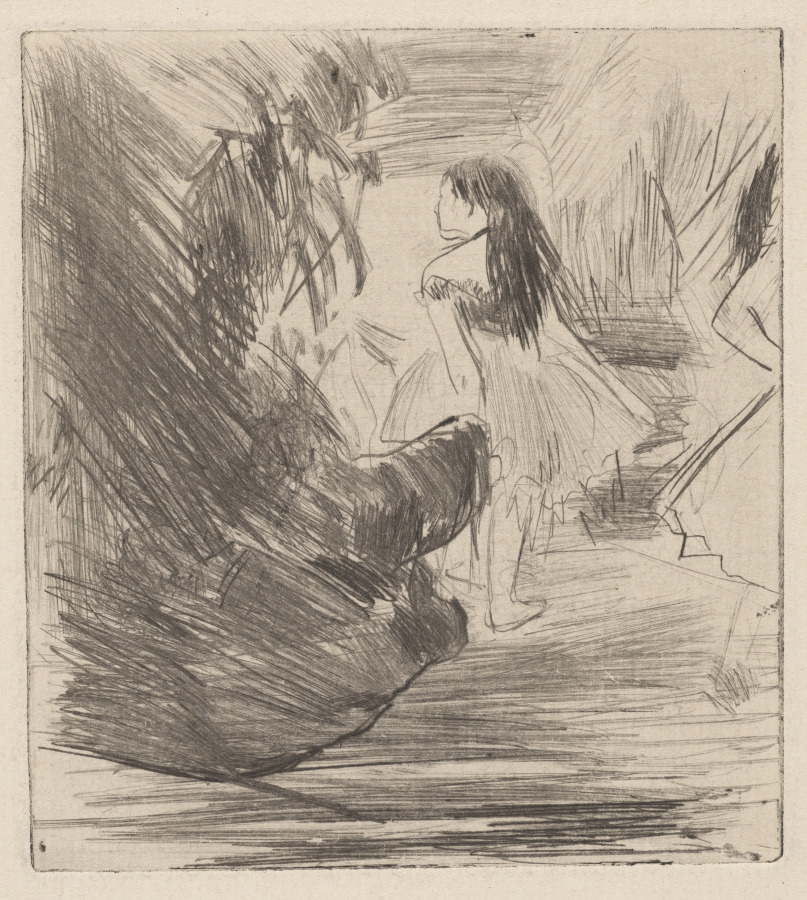
Two Dancers in the Wings (1879–80) is in the Cleveland Museum of Art collection. The museum's creator attribution is Edgar Degas (French, 1834–1917).
The work and its context
The museum's open-access catalogue describes the work:
Degas began to explore the intaglio printmaking techniques used to create Two Dancers in the Wings as early as the 1850s and saw prints as having an important part to play in the Impressionists’ group exhibitions. This work is the only one he created entirely using crayon électrique--a carbon rod used to incise the surface of a copper plate. Here, he used the diffuse lines created by this technique to portray the anxious stasis of two young ballerinas standing beside a massive, dark curtain, waiting to perform.
Object facts
- Title: Two Dancers in the Wings
- Date: 1879–80
- Creator attribution: Edgar Degas (French, 1834–1917)
- Culture: France
- Type: Print
- Technique: drypoint (crayon électrique)
- Dimensions: Sheet: 29.6 x 21.6 cm (11 5/8 x 8 1/2 in.); Image: 11.3 x 10.2 cm (4 7/16 x 4 in.)
- Collection: PR - Etching
- Department: Prints
- Accession number: 2026.52
A detail from the museum
Edgar Degas began to use carbon rods to create prints after a visit to his friend, industrialist and collector Alexis Rouart, who offered the artist this tool to create a print after he stayed overnight to avoid an impending snowstorm.
Collection credit
Dudley P. Allen Fund
View the collection record
See the museum's photographs and full catalogue entry. Catalogue text is reproduced from the Cleveland Museum of Art's open-access data, with HTML formatting removed. This object and its supplied image are designated CC0.
Sources
More in Lifestyle
Keep reading