Two-faced Carpet Fragment (1100s): Art, History and Details
Two-faced Carpet Fragment at the Cleveland Museum of Art: 1100s, senna knot. Explore the work's context, creator attribution and collection history.
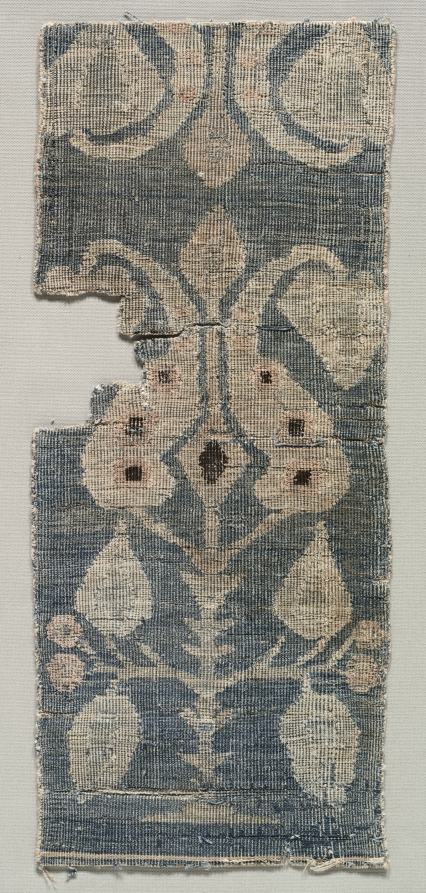
Two-faced Carpet Fragment (1100s) is in the Cleveland Museum of Art collection.
The work and its context
The museum's open-access catalogue describes the work:
This fragment preserves portions of designs of two faces of a carpet. One design depicts a stylized tulip with part of its mirror image. The opposite side depicts a pair of winged ibexes oriented at right angles to the "tulip" design.
Object facts
- Title: Two-faced Carpet Fragment
- Date: 1100s
- Culture: Iran ?, Seljuq period (1037–1194)
- Type: Textile
- Technique: senna knot
- Dimensions: Overall: 39.3 x 16.2 cm (15 1/2 x 6 3/8 in.)
- Collection: T - Islamic
- Department: Textiles
- Accession number: 1966.132
A detail from the museum
The tulip symbolizes modesty before God because, when in full bloom, it bows its head.
Collection credit
Gift of Mr. and Mrs. Werner Abegg
Further reading listed by the museum
- “Annual Report for 1966.” The Bulletin of the Cleveland Museum of Art, vol. 54, no. 6, 1967, pp. 159–197.
View the collection record
See the museum's photographs and full catalogue entry. Catalogue text is reproduced from the Cleveland Museum of Art's open-access data, with HTML formatting removed. This object and its supplied image are designated CC0.
Sources
More in Lifestyle
Keep reading