Two-Spouted Strainer Askos (Flask) (300–200 BCE): Art, History and Details
Two-Spouted Strainer Askos (Flask) at the Cleveland Museum of Art: 300–200 BCE, ceramic. Explore the work's context, creator attribution and collection history.
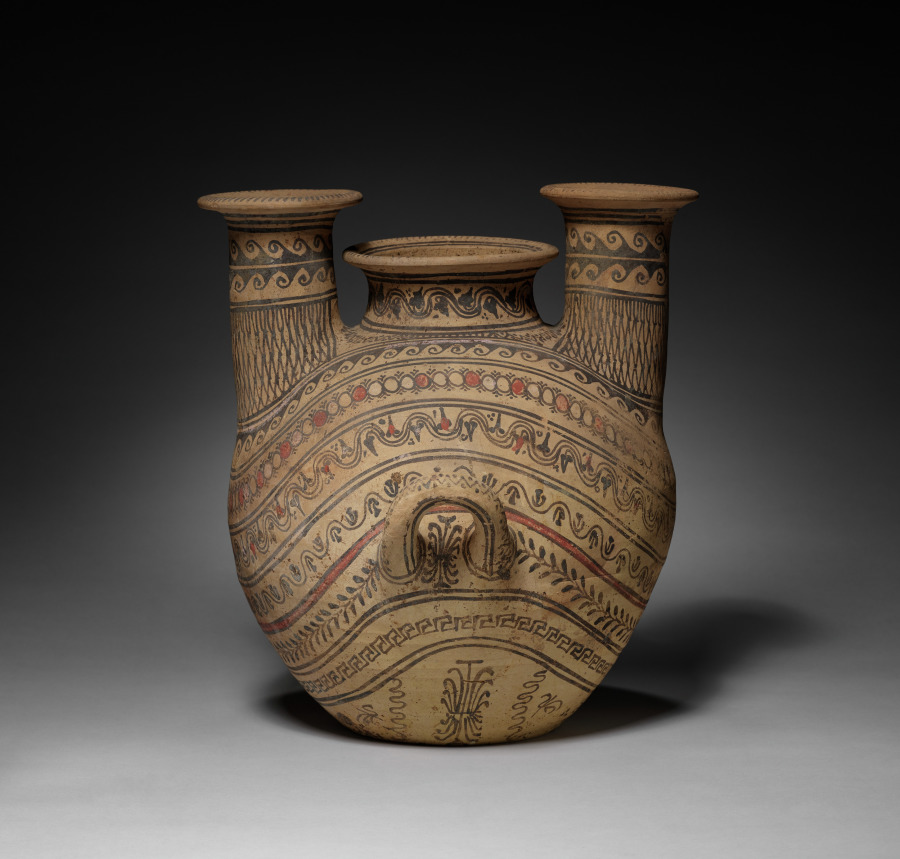
Two-Spouted Strainer Askos (Flask) (300–200 BCE) is in the Cleveland Museum of Art collection.
The work and its context
The museum's open-access catalogue describes the work:
Although now referred to by the Greek term askos, because of its resemblance to the animal skins used to hold wine in ancient Greece, this ceramic shape developed in the South Italian region of Daunia (north of Apulia, on the Adriatic coast). This example is unusual for its three openings—one covered by a lid, the others spouted with built-in strainers. Its profusely painted decoration, mostly geometric and vegetal patterns applied in black with added red and white, is arranged in bands that follow the contours of the vessel.
Object facts
- Title: Two-Spouted Strainer Askos (Flask)
- Date: 300–200 BCE
- Culture: South Italian, Daunian or Canosan
- Type: Ceramic
- Technique: ceramic
- Dimensions: Diameter of mouth: 14.5 cm (5 11/16 in.); Overall: 37 x 31 cm (14 9/16 x 12 3/16 in.)
- Collection: GR - South Italy
- Department: Greek and Roman Art
- Accession number: 1915.529.a
A detail from the museum
Each spout has a built-in strainer—one near the top, the other near the bottom.
Collection credit
Gift of the John Huntington Art and Polytechnic Trust
Further reading listed by the museum
- Beazley Archive. n.d. Beazley Archive Pottery Database. Oxford: Beazley Archive.
- Boulter, C. G., Jenifer Neils, and Gisela Walberg. Corpus Vasorum Antiquorum. Princeton, N.J.: Princeton University Press, 1971.
View the collection record
See the museum's photographs and full catalogue entry. Catalogue text is reproduced from the Cleveland Museum of Art's open-access data, with HTML formatting removed. This object and its supplied image are designated CC0.
Sources
More in Lifestyle
Keep reading