Two Tapestry-woven Panel Fragments (1000–1460s): Art, History and Details
Two Tapestry-woven Panel Fragments at the Cleveland Museum of Art: 1000–1460s, camelid fiber and cotton, tapestry weave. Explore the work's context, creator attribution and collection history.
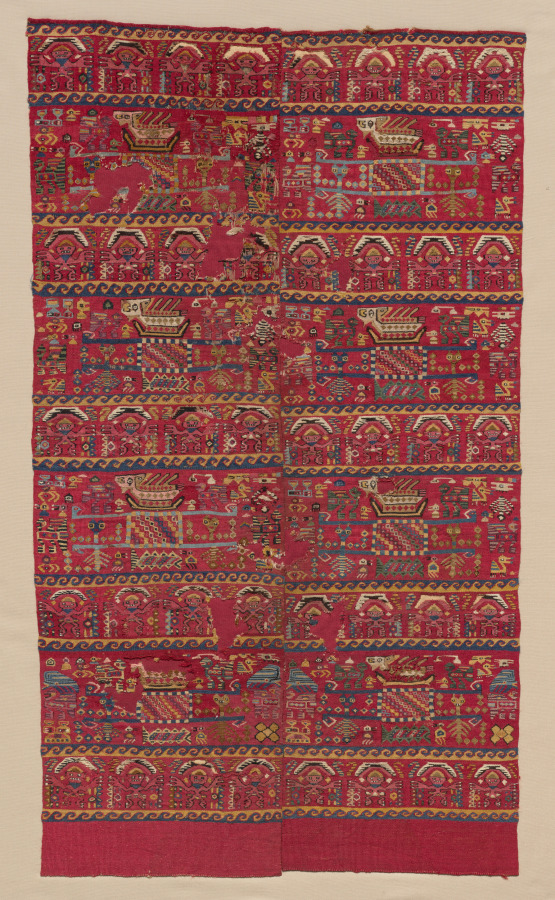
Two Tapestry-woven Panel Fragments (1000–1460s) is in the Cleveland Museum of Art collection.
The work and its context
The museum's open-access catalogue describes the work:
These two fragments, mounted side-by-side, come from the Chimú (chee-moo) Empire of Peru’s north coast. Each features horizontal rows containing four frontal figures. The rows alternate with wider registers, each with an H shape that represents a litter seen from above. A form of transport reserved for only the most esteemed members of society, the litter would have been carried by human porters via poles at each corner. Scattered around each are small creatures, including birds, a fish (located beneath), and two insect-like creatures posed as if they were carrying the litter. The objects hovering above the litter have not been identified.
Object facts
- Title: Two Tapestry-woven Panel Fragments
- Date: 1000–1460s
- Culture: Central Andes, North Coast, Chimú people
- Type: Tapestry
- Technique: camelid fiber and cotton, tapestry weave
- Dimensions: Overall: 88 x 51 cm (34 5/8 x 20 1/16 in.); Mounted: 99.1 x 63.5 cm (39 x 25 in.)
- Collection: T - Pre-Columbian
- Department: Textiles
- Accession number: 1985.7
Collection credit
Purchase from the J. H. Wade Fund
Further reading listed by the museum
- Turner, Evan H. “The Year in Review for 1984.” The Bulletin of the Cleveland Museum of Art 72, no. 2 (April 1985): 163–207.
View the collection record
See the museum's photographs and full catalogue entry. Catalogue text is reproduced from the Cleveland Museum of Art's open-access data, with HTML formatting removed. This object and its supplied image are designated CC0.
Sources
More in Lifestyle
Keep reading
Related stories