Vajravarahi (1300s): Art, History and Details
Vajravarahi at the Cleveland Museum of Art: 1300s, gilt bronze with turquoise inlay. Explore the work's context, creator attribution and collection history.
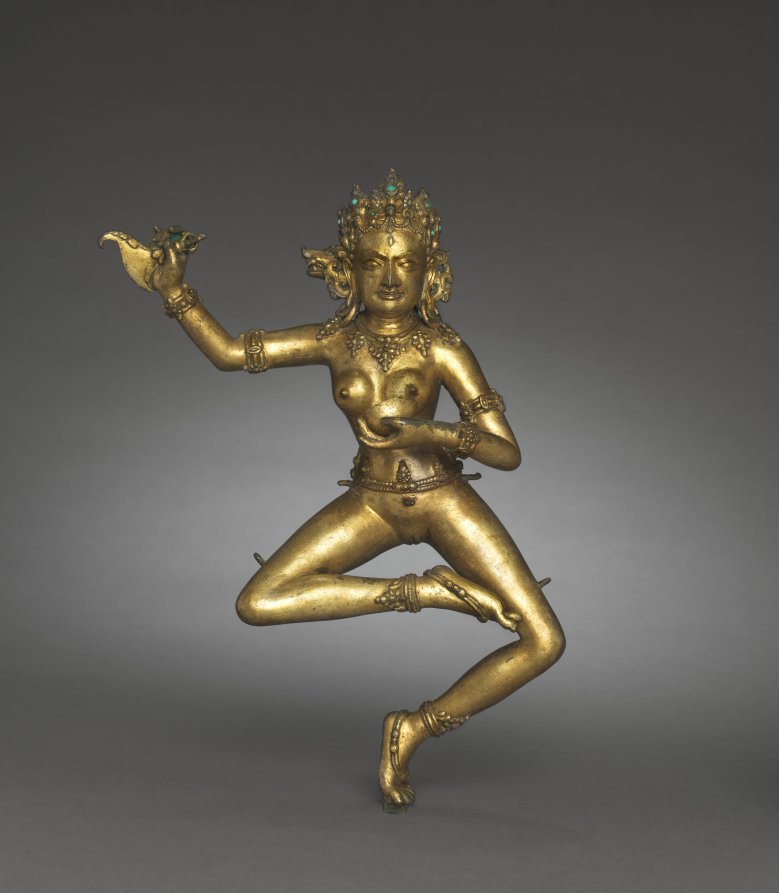
Vajravarahi (1300s) is in the Cleveland Museum of Art collection.
The work and its context
The museum's open-access catalogue describes the work:
Vajravarahi is the tantric Buddhist counterpart to the Hindu mother goddess Varahi, identifiable by the boar head emerging above her right ear. She is a female enlightened being who emanated from the Buddhist Goddess of Perfect Wisdom. Enlightened beings transcend gender distinctions, and they can emanate as either male or female. The lithe figure dances while carrying a skull cup in her left hand. Raised up in her right hand is a ritual flaying knife with a handle in the shape of a halfvajra, used for skinning the metaphorical beast of uncontrolled passions. The pegs cast into her lower body were for holding a bone skirt.
Object facts
- Title: Vajravarahi
- Date: 1300s
- Culture: Tibet
- Type: Sculpture
- Technique: gilt bronze with turquoise inlay
- Dimensions: Overall: 36 cm (14 3/16 in.)
- Collection: Tibetan Art
- Department: Indian and Southeast Asian Art
- Accession number: 1982.50
Collection credit
Leonard C. Hanna Jr. Fund
Further reading listed by the museum
- Lee, Sherman E. “Year in Review for 1982.” The Bulletin of the Cleveland Museum of Art 70, no. 1 (January 1983): 3–55.
- Reedy, Chandra L. Himalayan Bronzes: Technology, Style, and Choices. Newark, DE: University of Delaware Press, 1997.
- Cleveland Museum of Art. The CMA Companion: A Guide to the Cleveland Museum of Art. Cleveland: Cleveland Museum of Art, 2014.
View the collection record
See the museum's photographs and full catalogue entry. Catalogue text is reproduced from the Cleveland Museum of Art's open-access data, with HTML formatting removed. This object and its supplied image are designated CC0.
Sources
More in Lifestyle
Keep reading