Varaha, Boar Incarnation of Vishnu (700–800s): Art, History and Details
Varaha, Boar Incarnation of Vishnu at the Cleveland Museum of Art: 700–800s, sandstone. Explore the work's context, creator attribution and collection history.
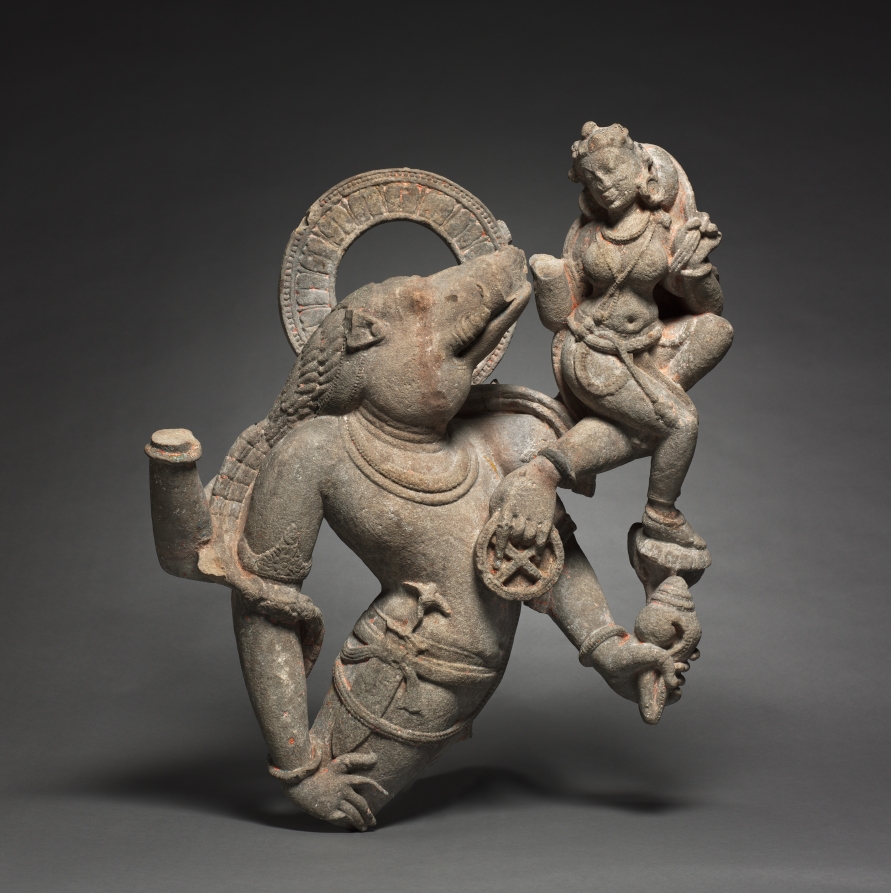
Varaha, Boar Incarnation of Vishnu (700–800s) is in the Cleveland Museum of Art collection.
The work and its context
The museum's open-access catalogue describes the work:
The Hindu god Vishnu took the form of a boar to rescue his wife Bhu (Earth in Sanskrit) from the bottom of the primordial ocean, where she had been hidden by a demon. Here shown with the head of a boar and the powerful lunging body of a warrior, Varaha holds out one of his four elbows as a seat for the earth goddess who he has rescued.
Object facts
- Title: Varaha, Boar Incarnation of Vishnu
- Date: 700–800s
- Culture: Central India, probably Madhya Pradesh
- Type: Stone
- Technique: sandstone
- Dimensions: Overall: 82 x 68.5 x 33.5 cm (32 5/16 x 26 15/16 x 13 3/16 in.)
- Collection: Indian Art - Medieval
- Department: Indian and Southeast Asian Art
- Accession number: 2011.148
A detail from the museum
In his two left hands, he hold the conch and discus.
Collection credit
Gift of Maxeen and John Flower in honor of Dr. Stanislaw Czuma
Further reading listed by the museum
- “Art of Asia Acquired by North American Museums, 2010-2011.” Archives of Asian Art, vol. 62, 2012, pp. 105–153.
- Czuma, Stanislaw J. "A Shared Passion." Cleveland Art: Cleveland Museum of Art Members Magazine 52, no. 2 (March/April 2012): 7–9.
View the collection record
See the museum's photographs and full catalogue entry. Catalogue text is reproduced from the Cleveland Museum of Art's open-access data, with HTML formatting removed. This object and its supplied image are designated CC0.
Sources
More in Lifestyle
Keep reading