Vase (c. late 600s–early 700s): Art, History and Details
Vase at the Cleveland Museum of Art: c. late 600s–early 700s, silver with gilded foil. Explore the work's context, creator attribution and collection history.
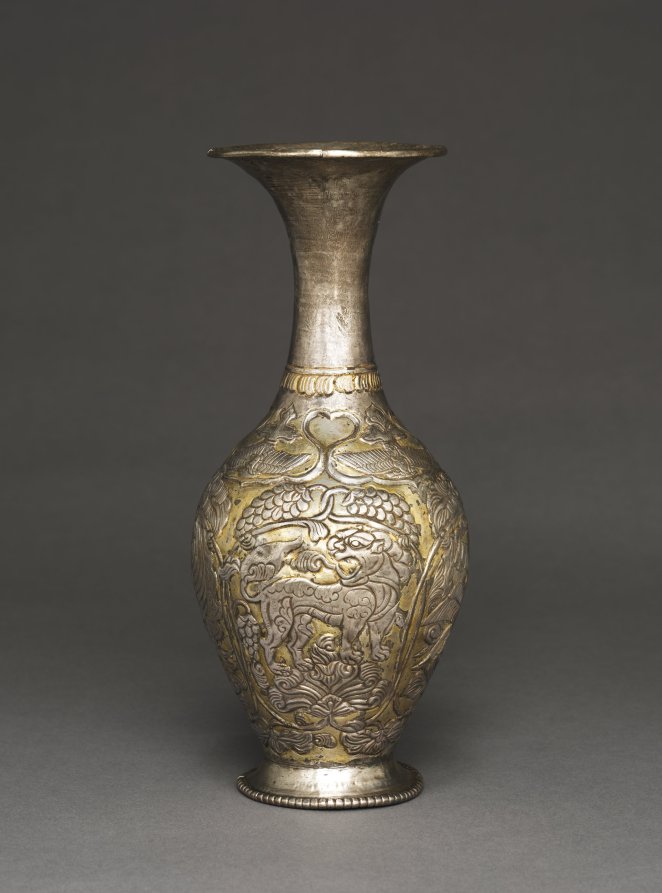
Vase (c. late 600s–early 700s) is in the Cleveland Museum of Art collection.
The work and its context
The museum's open-access catalogue describes the work:
Located amid the vast “silk roads” trade network, medieval Tibet was a place of dynamic cultural exchange. This decanter is evidence of such interactions. The vessel is part of the tableware used to hold wine during feasts. Tibetan elites adopted the tradition of consuming wine at social gatherings from their Iranian (Persian) contemporaries, whose wine banquets were lavish affairs with plentiful food and drink.
Object facts
- Title: Vase
- Date: c. late 600s–early 700s
- Culture: Central Asia (Sogdiana) or Tibet
- Type: Silver
- Technique: silver with gilded foil
- Dimensions: Overall: 22.9 cm (9 in.);
- Collection: Tibetan Art
- Department: Indian and Southeast Asian Art
- Accession number: 1988.67.1
A detail from the museum
Lions were often seen as powerful protectors while phoenixes were associated with good fortune.
Collection credit
Purchase from the J. H. Wade Fund
Further reading listed by the museum
- “The Year in Review for 1988.” The Bulletin of the Cleveland Museum of Art 76, no. 2 (February 1989): 30–75.
- Czuma, Stan. "Museum Acquisitions and Notes." Bulletin of the Asia Institute vol. 5 (1991), 190.
- “Recent Acquisitions at the Cleveland Museum of Art II: Departments of Asian Art: Supplement.” The Burlington Magazine 133, no. 1059 (June 1991): 417–424.
View the collection record
See the museum's photographs and full catalogue entry. Catalogue text is reproduced from the Cleveland Museum of Art's open-access data, with HTML formatting removed. This object and its supplied image are designated CC0.
Sources
More in Lifestyle
Keep reading