Vasudhara, Goddess of Abundance (1300s–1400s): Art, History and Details
Vasudhara, Goddess of Abundance at the Cleveland Museum of Art: 1300s–1400s, gilt bronze and semiprecious stones. Explore the work's context, creator attribution and collection history.
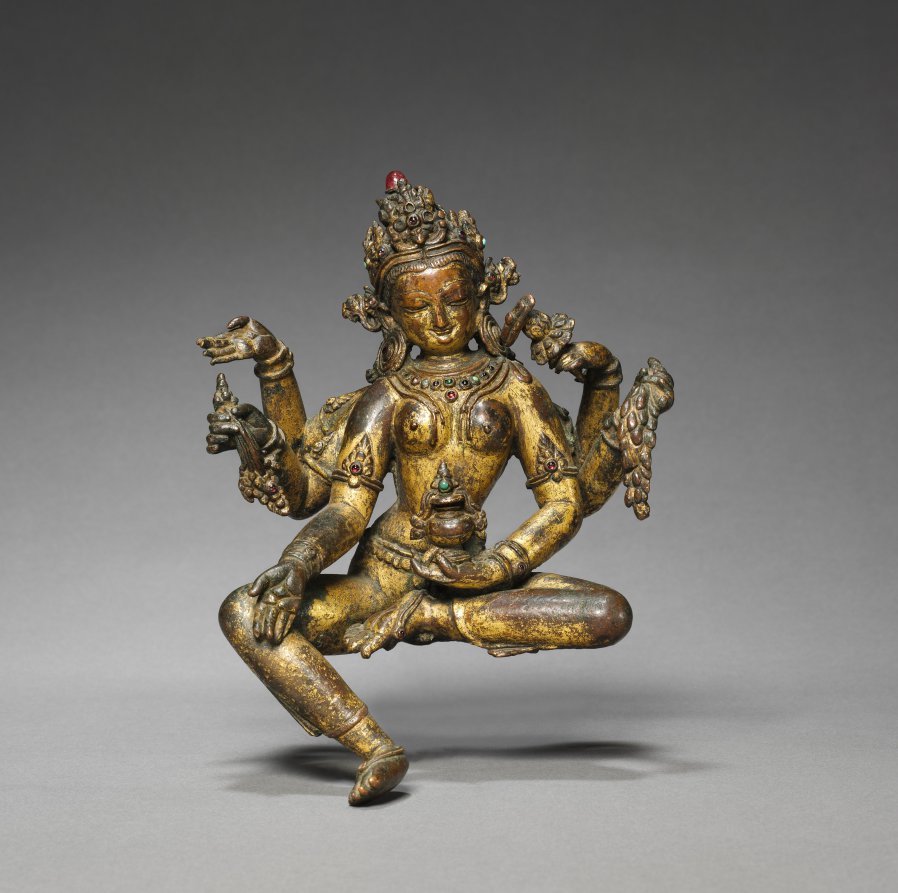
Vasudhara, Goddess of Abundance (1300s–1400s) is in the Cleveland Museum of Art collection.
The work and its context
The museum's open-access catalogue describes the work:
In Nepal this female counterpart of the god of wealth is one of the most popular divinities. This image was set up in either a domestic shrine or a Buddhist monastery, where devotees would pray to her for wealth, prosperity, and children. In each of her six arms she holds objects pertaining to life and abundance: jewels, an overflowing pot, and a sheaf of wheat. A Buddhist philosophical text rests on top of the lotus flower she holds in her topmost left hand, suggesting that wealth and prosperity can derive from the acquisition of true knowledge.
Object facts
- Title: Vasudhara, Goddess of Abundance
- Date: 1300s–1400s
- Culture: Nepal
- Type: Sculpture
- Technique: gilt bronze and semiprecious stones
- Dimensions: Overall: 16.2 cm (6 3/8 in.)
- Collection: Nepalese Art
- Department: Indian and Southeast Asian Art
- Accession number: 1947.493
Collection credit
Purchase from the J. H. Wade Fund
Further reading listed by the museum
- Hollis, Howard. "A Nepalese Gilt-Copper Image." The Bulletin of the Cleveland Museum of Art 35,, no. 3 (March 1948): 39–40.
- The Cleveland Museum of Art. The Cleveland Museum of Art Handbook. Cleveland, OH: The Cleveland Museum of Art, 1958.
- Kramrisch, Stella. The Art of Nepal. New York: Distributed by H.N. Abrams, 1964.
View the collection record
See the museum's photographs and full catalogue entry. Catalogue text is reproduced from the Cleveland Museum of Art's open-access data, with HTML formatting removed. This object and its supplied image are designated CC0.
Sources
More in Lifestyle
Keep reading